A whole document — and where it is blank, it names where to look
Most household paperwork asks you to do the work. You get a blank template, a folder, a checklist of things to gather — and it sits unfinished, because assembling it is the hard part.
This runs the other way round. You are asked nothing before you buy. What arrives is the whole document, ordered and labelled part by part, with a ruled line waiting for each fact particular to your household.
Seven parts, in the order someone would actually need them, with the deadlines that follow spelled out and the gaps named rather than quietly left blank.
It arrives by email as a finished PDF in two copies — one to print and write on, one to type into on screen — and it comes with no queue and no office hours. It comes with The Handover Guide — its 33-page companion, free to read first — alongside.
What is actually in it
Seven parts, in this order. The order is the point — it is the sequence someone works through on the worst morning of their life, not an alphabetical index.
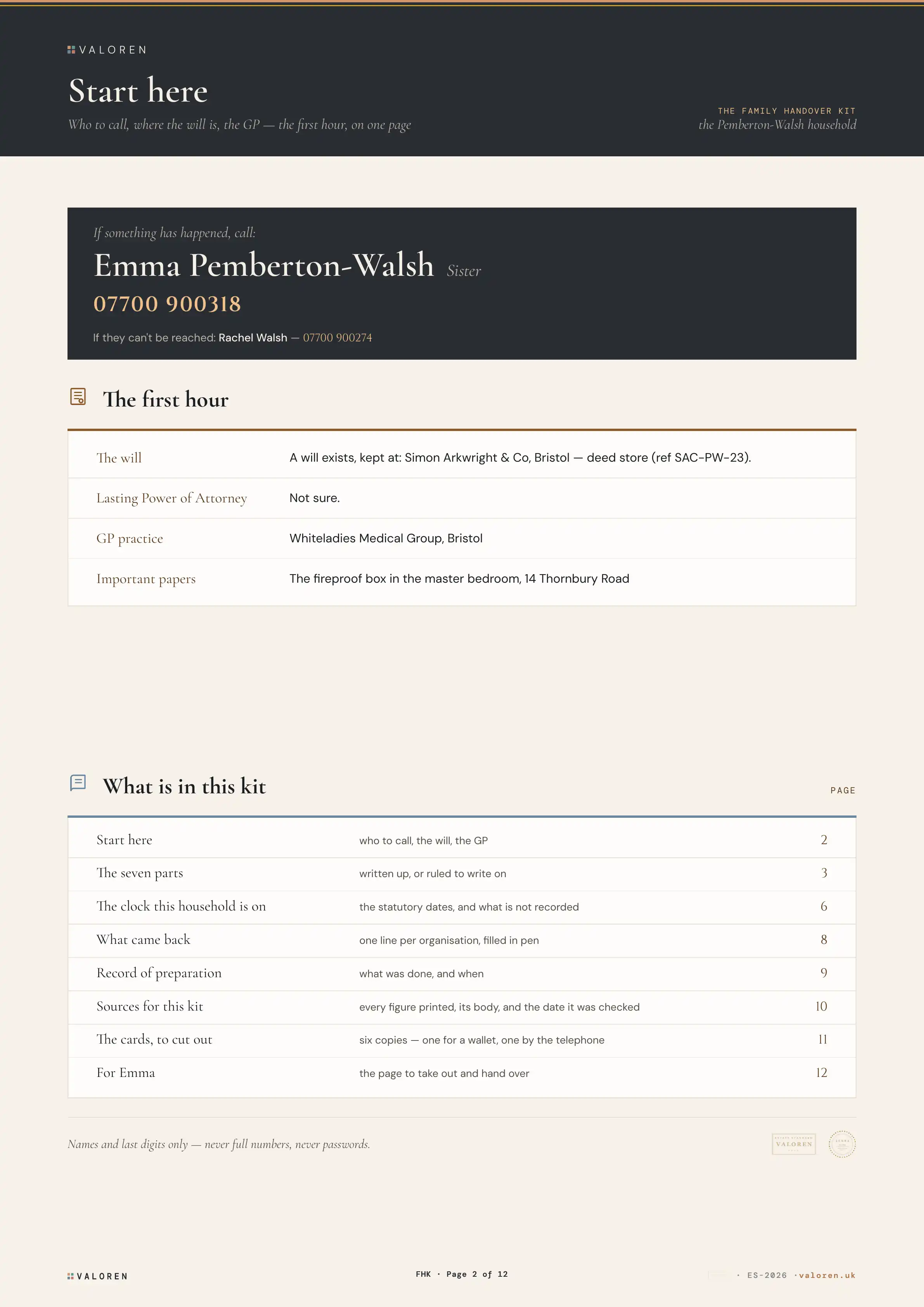
What comes back
A specimen for an invented household — the real composition, not a real family. The Start here page: who to call, the will, the LPA, the GP. It arrives ruled and ready to write in, and reads like this once the details are filled in.
Who to call first
One named person, with a phone number that works. Everything else waits; this doesn't.
and a second name, in case the first can't be reached
Where things are kept
The drawer, the safe, the solicitor's office — named, not assumed.
including who else already has access
The legal position
Whether a will exists and where. Whether a Lasting Power of Attorney (LPA) is registered — and for what.
the single highest-value line in the brief — an unregistered LPA can't be acted on if capacity is lost
The medical essentials
GP, medications, allergies. The questions a hospital asks in the first hour.
asked in the order a triage nurse asks them
The financial picture
Which banks, which policies, which pensions — names, not balances. Enough to notify, not enough to steal.
deliberately no account numbers — this is a document that may sit in a drawer
Digital access
The recovery routes for email and phone. Without these, half of modern life is simply locked.
the two accounts every other account resets through
Funeral wishes
Burial or cremation, whether a plan is already paid for, and where fuller wishes are kept. One decision the family never has to make blind.
entirely optional — a household that skips it simply doesn't carry the page
All seven parts arrive whether or not you have the answers to hand. Where a fact is missing, the Kit does not simply leave a line blank — it names the fact and the body that already holds it: the National Will Register for a will, the Office of the Public Guardian on form OPG100 for an LPA, the NHS find-a-GP service, the government's Pension Tracing Service for an old workplace pension, and the legacy-contact schemes at Apple, Google and Facebook.
How it works
You pay and it arrives. The third step is optional, and it is already paid for.
You pay £29. No account to create, no password to remember. Card, Apple Pay or Link.
It arrives by email, with no queue and no office hours. Nothing is asked of you first, and nothing is left pending. Three files land in your inbox: the Kit itself, the same document with typeable fields so it can be filled in on screen, and The Handover Guide, its 33-page companion.
If you want it prepared with your own details, that is included. Whenever suits you — the link does not expire. That edition is written up from your details and read through by a person before it is sent, and it comes back within one business day of your details.
Add a postal address with your answers and that edition is printed and posted to you as well — included, allow up to 10 working days.
One-off. No subscription, no account. Delivered with no queue and no office hours.
If you later take The Household Continuity Dossier within 30 days, the £29 counts in full toward it — same email at checkout, applies by itself.
There is a free version, and you should try it first
The Family Handover Kit checklist covers the same ground and costs nothing. If you will genuinely sit down and fill it in, it is the right answer and you should not buy this.
The difference is who does the assembling. The checklist is a structure you complete.
This is the whole document built around that structure: a contents list at the front, all seven parts titled and ruled with a line waiting for each fact, a dated page of what falls due when, and a sheet of cut-out cards for a wallet and beside the telephone. Where the checklist would leave a blank, this names the body that already holds the answer.
Most people who buy this have already downloaded the free one and not finished it. That is not a failure of will — assembling a document about your own death is genuinely unpleasant, and the hardest part of it is working out what belongs in it at all. That part arrives already done.
See the free checklist first →What a £29 kit usually gets you — and what this one does.
Every kit in this category does the same job — who to call, where things are, what falls due. The difference is how much of it is already done, what happens to the lines you can't fill in, and what arrives. Every cell below is something you can check for yourself.
| A free workbook | A PDF kit you print | A printed planner | The Family Handover Kit | |
|---|---|---|---|---|
| Filled in for you? | No — you write it in by hand. | No — download, print, fill it in. | No — blank pages to complete. | You write it in — by hand, or typed into the on-screen copy. What is already done is the harder half: the seven parts in the right order, the contents page, and the dates that fall due. |
| Read by a person before it's sent? | No. | No — an instant download. | No. | Yes — on the prepared edition: included, with no deadline; what comes back is written up from your details and read through by a person before it is sent. |
| Who you still have to tell | A blank list to complete. | A blank list to complete. | Blank pages to complete. | Ruled rows for banks, pensions and insurers — with where to look: a pension that has gone quiet is traced through the government's Pension Tracing Service, named on the page. |
| A line you can't answer yet | Printed anyway, left blank. | Printed anyway, left blank. | Printed anyway, left blank. | Ruled, and routed — each prints its own labelled line, and the ones still open are gathered in one list, most of them naming who already holds the answer: the National Will Register for a will, the Office of the Public Guardian for an LPA. |
| Cards to carry | None. | None. | Blank tags, in some. | Cut-out cards — six of them, ruled to write on, for a wallet or by the telephone. Written up for you if you take up the prepared edition. |
| How it arrives | Posted, free, as a blank booklet. | On your own printer. | In the post, blank. | In your inbox within a minute, with the 33-page Guide · nothing to fill in first. |
| How fast | Days to weeks (posted). | Immediately — because nothing was written. | Days (posted). | No queue, no office hours. |
| Kept current afterwards? | Only if you rewrite it. | Only if you re-print it. | Only if you re-write it. | The Kit is a snapshot. The Household Continuity Dossier keeps it current and includes the will. |
| Price | Free. | About £15–£29; bundles to about £76. | About £30–£45. | £29, one-off. The £29 comes off the Dossier's first year if you move up within 30 days. |
| If it isn't right | — | Typically 14–30 days money back; check the seller. | Retailer's returns policy. | 30-day money-back. |
The category, by shape of product — no single seller is named; prices are the published ranges seen on 21 August 2026.
Who builds this, and what we won't claim
Valoren is new, and we publish nothing we can't stand behind — no star ratings, no invented testimonials, no borrowed photographs of families who don't exist.
What we can give you is transparency: what is actually inside the document, the terms in plain English, and a way to check every claim for yourself.
The Kit itself is not read by anyone before it reaches you — until you write in it, there is nothing in it about you. The prepared edition is different: it is read by a person before it goes out, and at our size that person is a named human being rather than a queue, which is why that edition takes a business day, while the Kit itself has no queue behind it.
What early households say
A real eye-opener
My husband and I thought we'd already done this. We'd written out the ‘important’ details, bank accounts and so on. Then I read the kit and there was quite a bit I'd never thought of. A real eye-opener, and a very worthwhile investment. So pleased I got it.
One step towards easing it for my family
I've wanted to do this for a very long time. It's never an easy time for anyone, but with everything gathered in one folder it must surely ease the strain on my family when the time comes. Joel was so helpful with the documents, and offered more help if I need it. Thank you Joel 💖
Very easy to use
Broken down into simple steps, what to do and when. Very easy to use. Hopefully it makes things easier for my children when the time comes.
Questions people ask before buying
Why would a household need this at all?
Because of what the first fortnight actually looks like. Banks usually freeze a sole account once they are told of a death, so money sitting in an account is not the same thing as your family being able to reach it.
Tell Us Once notifies government departments — not the banks, insurers or pension providers, who each have to be told separately. And between the death and the point where an estate can properly be dealt with, no single organisation owns the job of telling your family what to do first.
That stretch is what this brief is written for: who to call, where things are kept, and what falls due when — set down in your household's own facts, before anybody needs it.
How is this different from the free checklist?
The free Family Handover Kit checklist is a bare structure — headings, and blank lines beneath them. The Kit is the whole document built around that structure: a contents list at the front, all seven parts titled and ruled with a line waiting for each fact, a dated page of what falls due when, and a sheet of cut-out cards for a wallet and beside the telephone.
And where the checklist would leave a blank, the Kit names the body that already holds the answer — the National Will Register for a will, the Office of the Public Guardian on form OPG100 for an LPA, the government's Pension Tracing Service for an old workplace pension.
What actually arrives?
Three files, by email: the Kit itself in seven parts, opening on a Start here page — the first call, the will, the LPA, the GP; the same document with typeable fields, so it can be filled in on screen; and The Handover Guide, its 33-page companion.
It arrives by email with no queue and no office hours. The Guide is free to read first at valoren.uk/resources/the-handover-guide. If you take up the included option to have your own details written in and add a postal address, that prepared edition is printed and posted to you as well — included.
Do I need an account?
No. You pay, and it comes to the address you paid from — nothing to set up, nothing to sign into. No password, no subscription, nothing to cancel.
If I add my own details later, what happens to them?
They are used to prepare your edition of the Kit and nothing else.
Either way, the document asks for names rather than numbers — which bank, not which account — so it is safe to leave in a drawer.
Do I have to fill anything in?
No. The Kit arrives complete and nothing is asked of you.
If you would like it prepared with your household's own details written in, that is included in the £29, whenever suits you. That edition is read through by a person and comes back within one business day of your details, by email and, if you add an address, in the post.
Can I change it afterwards?
Reply to the delivery email and a person reads it. The brief is a document about a household, and households change — a correction is normal, not an exception.