Skip to content
The role, in plain English

What is a trusted person?

A trusted person is someone you name to be contacted and trusted if you are ever seriously ill or die. They would be handed a clear picture of your affairs, so that nothing has to be reconstructed in a hurry.

It is not a legal office. It is a chosen, named point of contact, given on purpose to someone whose judgement you trust.

Valoren keeps everything your family will need, ready before they need itone calm place for where everything is, who to tell, and who would step in. It is free to begin, with nothing to pay until you choose a paid plan.

How to name one
I

A trusted person, and what it is not

The idea is often confused with the legal roles that sit near it. The difference is simple: a trusted person is a human contact, not a holder of legal power. Here is how the four compare.

Trusted personIllness or death · Not a legal office

A named, human contact who is told where things are and who to call. Chosen by hand — holds no legal power.

ExecutorAfter death · Named in a will

Administers the estate under the will. Collects assets, pays debts, distributes what remains.

Attorney (LPA)Alive, lacks capacity · Registered legal power

Holds legal authority to make decisions about money or health. Applies while the person is living but unable to decide.

Next of kinAny time · A relationship, not a role

The closest living relative. Often consulted by hospitals, but holds no automatic legal authority in England and Wales.

II

What the role involves, in practice

01

The first call

If the day comes, the trusted person is among the first told. Not to take charge of everything — to know, early, so the right things happen in the right order.

02

The handover

They receive the practical picture that was prepared in advance: where documents are, which accounts exist, who to contact, and any wishes recorded.

03

The record

They lean on a record kept current over time, rather than reconstructing a life from memory and guesswork in the hardest week to be doing it.

III

How to name a trusted person

Naming a trusted person is a decision, not a legal procedure. You choose someone whose judgement you trust to act calmly under pressure.

You tell them, plainly, that you would want them contacted — so it is never a surprise on the worst day. And you record their details alongside the practical picture they would receive, so the role can actually be carried out.

Valoren's First Sitting — a guided start you can do at the kitchen table, in about ten minutes — and trusted-person planner walk through exactly these steps — choosing, recording, and preparing what the person would receive — at your own pace.

IV

Have you been named as one?

If someone has named you as their trusted person, there is nothing to do today and nothing to pay. The page for trusted persons explains what would reach you if you were ever called upon, and why the role asks so little of you now.
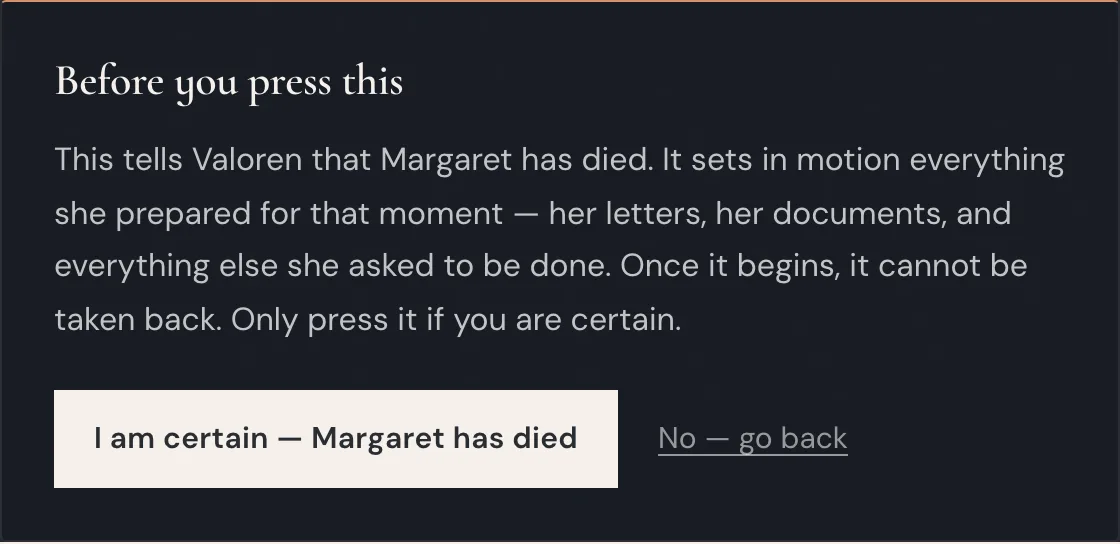

The confirmation gate a trusted person passes before anything is released.
the confirmation gate
Nothing is released by one click. The gate your person passes is deliberate — the safeguard window and a human check stand between a request and a release.
?

Common questions

No. An executor administers your estate after death under your will and holds a legal role.

A trusted person is a named human contact who is told where things are and who to call — they hold no legal power.
No. A trusted person is not a legal office.

Legal authority during your lifetime comes from a registered Lasting Power of Attorney; authority after death comes from being an executor or administrator. A trusted person sits alongside these as a chosen point of contact.
You choose someone whose judgement you trust, tell them, and record their details together with the practical picture they would receive.

Valoren's First Sitting and trusted-person planner walk through exactly this.
No. A trusted contact is a person you give a bank or investment firm so they have someone to reach if they cannot contact you or are concerned about your account — it sits with that one provider.

A trusted person, here, is your own chosen contact across your whole life — told where things are and who to call if you are ever seriously ill or die. You can have both, and they need not be the same person.
No. A trusted adult is safeguarding language — a safe grown-up a child or young person can turn to.

The trusted person described here is an estate-planning role for an adult's own affairs: a named contact who would receive the practical picture of where everything is. The words are similar; the meaning is different.
The one-screen handover view a trusted person opens — everything prepared for them, in one place.
the page your person opens
one link · no account
everything they need, in order
See how the handover works
Where to go next

Choosing, being chosen, or planning ahead

A trusted person is a name, given on purpose, to someone you trust.

It costs nothing to decide who yours would be — and it can save the people you love a great deal at the moment they can least afford the search.

Name your trusted person
Not ready today?

This page will still be here.

Leave an email and we'll send you a link back.

Send this to Valoren. It reaches a real person.

It reaches a real person · Privacy
Plate R · Related

If this was useful, you might also need —

Part of a working library79form walkthroughs90+free guidesevery calculator & checker