Skip to content
G-05 · Free DownloadEstate administration · England & Wales

Blank Executor Checklist

A complete time-phased checklist for administering an estate from start to finish — 0–7 days through 6–12 months, with a date column for each item. No account required.

Download free PDF →

PDF · No account required · Planning guide only — not legal advice

Planning guidance only. Executor duties and IHT rules change. Verify current deadlines at gov.uk/probate and hmrc.gov.uk. Complex estates — foreign assets, trusts, business interests, or disputed wills — benefit from professional advice. This checklist covers England and Wales; Scotland and Northern Ireland have different rules.

What an executor does

An executor is the person named in a will to administer the estate after death. Their job is to collect assets, pay debts and taxes, and distribute what remains to the beneficiaries. It is a legally responsible role that typically takes 6–12 months for a straightforward estate.

Collect
Gather all assets into the estate: bank accounts, investments, property proceeds, insurance payouts, pension lump sums.
Pay
Clear all debts in the correct priority order — funeral expenses, then secured debts, then unsecured creditors — before distributing anything.
Distribute
Transfer the residue to beneficiaries per the will, having obtained their signed receipts and maintained proper accounts throughout.

The four phases

The checklist is built around four time phases. Not every item applies to every estate; mark items not applicable and note why.

0–7 daysThe immediate steps
Get the Medical Certificate of Cause of Death
Register the death within 5 days of the medical examiner's go-ahead (8 in Scotland)
Locate the will and confirm you are named executor
Contact the main bank to notify of death
Cancel State Pension / benefits via Tell Us Once
Instruct a funeral director
Notify employer if deceased was still working

The first week is about documentation, not administration. You cannot deal formally with assets until you have the grant of probate — but you can gather the information you will need.

7–28 daysNotifications and estate mapping
Notify all banks and financial institutions
Notify all pension providers separately (Tell Us Once doesn't reach them)
Notify life insurance providers — policies in trust pay direct to beneficiaries
Redirect post to the executor's address
Obtain valuations: property (RICS), investments, jewellery, vehicles
List all debts and liabilities
Search for unknown assets via My Lost Account

Post redirection is often forgotten and catches significant financial correspondence in the weeks after death.

1–6 monthsAdministration and probate
Apply for Grant of Probate (PA1P) or Letters of Administration (PA1A)
Complete IHT400 or confirm excepted estate (deaths on/after 1 Jan 2022)
Open an executor's bank account
Place a creditor advertisement under Trustee Act 1925 s.27
Collect cash in bank accounts
Deal with investments and share registrars
Pay all estate debts in priority order

IHT must be paid before the grant of probate is issued. Banks can release funds to pay IHT against the death certificate in some cases.

6–12 monthsDistribution and close-out
Transfer or sell property (AS1 assent or conveyancing sale)
Prepare the estate accounts
Obtain written receipts from beneficiaries
Distribute specific legacies named in the will
Distribute the residuary estate
File final IHT return if applicable
Retain all estate documents for 6 years (HMRC enquiry window)

Beneficiaries are entitled to see the estate accounts. Keep them clear and dated.

Get these deadlines on your own calendarFree · .ics file

Enter the date of death and download a calendar file with the real dates already worked out. It opens in Google Calendar, Outlook, or Apple Calendar. The date stays in this browser — nothing is sent anywhere and nothing is saved.

  • Register the death — 5 days (statutory, England & Wales)
  • Inheritance Tax payment due — end of the sixth month after the month of death (statutory)
  • IHT400 account delivery deadline — 12 months from the end of the month of death (statutory)
  • Plus three planning milestones from this checklist's own phases — clearly labelled guidance only, never a legal deadline

Planning guidance only, not legal advice. England and Wales — Scotland and Northern Ireland have different registration deadlines. Verify current deadlines at gov.uk/probate and hmrc.gov.uk.

Common executor mistakes

Five errors that appear repeatedly in executor administration.

1
Distributing before all debts are paid
Executors are personally liable for distributing assets to beneficiaries before debts are cleared, if creditors then cannot be paid. The estate pays debts first; what remains is for the beneficiaries.
2
Closing bank accounts too early
Banks require the grant of probate to release funds from sole accounts. Asking to close an account before probate can delay the process and create administrative problems. Notify the bank; wait for the grant.
3
Ignoring pension providers
Tell Us Once notifies DWP and HMRC, but not occupational or private pension schemes. Each scheme must be notified separately with the death certificate. Expression of wishes records held with the scheme determine who receives the pension pot — but only if the provider knows the member has died.
4
Forgetting the IHT deadline
Inheritance tax must normally be paid within 6 months of the end of the month of death. Interest accrues after that date even if probate has not yet been granted. Estate assets (bank account funds, life insurance) can be used to make a payment on account early in the process.
5
Treating a grant of probate as instant
HMRC must process IHT accounts before the probate application can proceed for taxable estates — allow at least 20 working days. The Probate Registry then takes 6–16 weeks. Plan the estate's financial needs around these timelines.

Download the checklist

FreeA4 PDFEngland & WalesEdition 2026
Blank Executor Checklist

Four time phases, 30 checklist items, a date column for each, reference block at the top, and a creditor advertisement reminder. A4 print-ready.

Download — Blank Executor Checklist (PDF)
Starting point only. Not legal advice. England and Wales.
Take it with you

Take the executor checklist with you.

We'll email you the executor checklist as a PDF — for when you're at a printer, or to pass to the person who'll need it. The download above stays free either way.

Email me the executor checklist as a PDF.

It reaches a real person · Privacy

Working for a hospice, charity, council or carers' service? You're welcome to link the checklist, print it, or put it in a bereavement pack — free, no permission needed, nothing expected in return. See everything that's free

Go further — the prepared executor pack

The checklist tells you what to do in general. The Executor's First Hour Pack tells you what to do for this specific estate — with names, references, and contacts already in place.
Executor's First Hour Pack£179

A prepared document set produced from the portal records. Covers the same four phases but with the estate's specific accounts, contacts, and reference numbers already named — the executor opens it and knows what to do for this estate, not just any estate.

The £179 counts in full toward the Household Continuity Dossier’s first year for 30 days — nothing you start with is wasted.

Executor's First Hour Pack
Start your estate record

Questions, answered plainly

No. There is no legal requirement for a solicitor. Many executors administer straightforward estates themselves, using checklists and guidance.

Solicitors add value for complex estates: foreign assets, business interests, trusts, disputed wills, or where the executor lives overseas or is not confident in the role. For a standard estate — UK assets, no trusts, no disputes — a capable executor with good organisation can administer it without professional help. The Probate Registry's online portal accepts applications directly.
Without a will, there is no named executor. The estate is distributed according to the intestacy rules (set out in the Administration of Estates Act 1925), and the person who acts must apply for Letters of Administration rather than a Grant of Probate.

Use the PA1A form. The checklist applies equally — the process is the same, but the order of beneficiaries is fixed by law rather than set out in a will.
A professional executor (a solicitor or trust company) can charge fees. A lay executor — a family member or friend named in the will — is not automatically entitled to payment; they can recover out-of-pocket expenses from the estate.

If the will grants a fee, that is permissible. If not, an agreement with the beneficiaries for a payment is possible, but any payment comes from their share. Most lay executors do not charge.
A straightforward estate typically takes 6–12 months from death to distribution.

With a property to sell or inheritance tax to resolve, 12–18 months is normal — and 18–24 months is not uncommon where trusts or a dispute are involved. The most common cause of delay is waiting for the grant of probate and for each institution to process its own paperwork once the grant is obtained.
A grant of probate is issued when there is a valid will and the named executor applies. Letters of Administration are issued when there is no valid will, or when the executor cannot or will not act.

Both documents give the holder legal authority to collect assets and pay debts. The difference is in the application form: PA1P for probate, PA1A for administration.
This checklist is a blank, paper-based starting point — it covers the full twelve-month process in sequence.

The Executor's First Hour Pack (£179 via valoren.uk) is a prepared, personalised document set: it uses the portal records to produce a briefing that names the accounts, the contacts, and the specific steps relevant to that particular estate — rather than a generic list. The checklist tells you what to do in general; the pack tells you what to do for this specific estate.
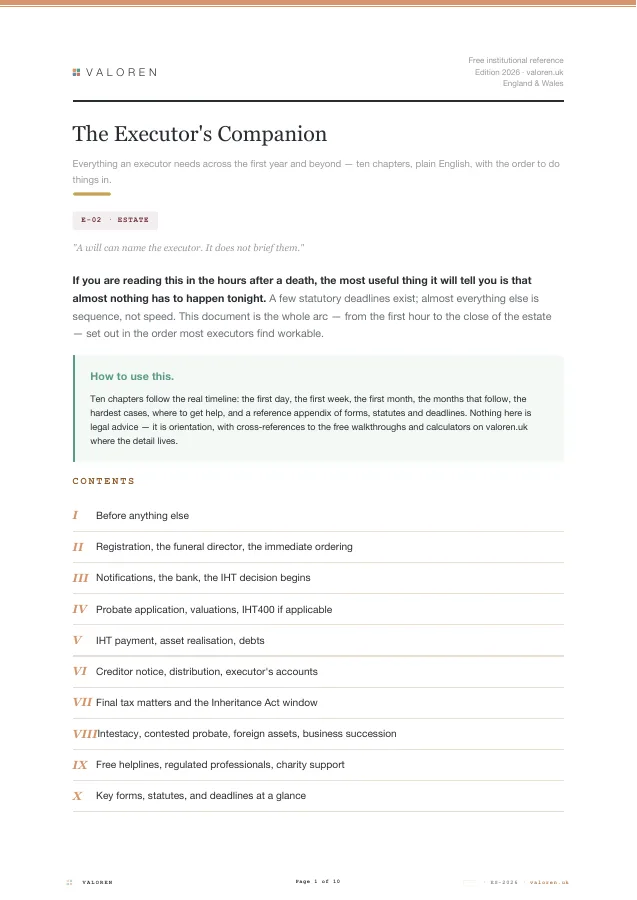
First page of the Executor's Companion guide.

the companion

the full guide this checklist comes from · prepared, kept current

Plate R · Related

If this was useful, you might also need —

Part of a working library79form walkthroughs90+free guidesevery calculator & checker