Skip to content
Personal Records · Legacy Letters

Legacy letters: what to write, and where they need to live

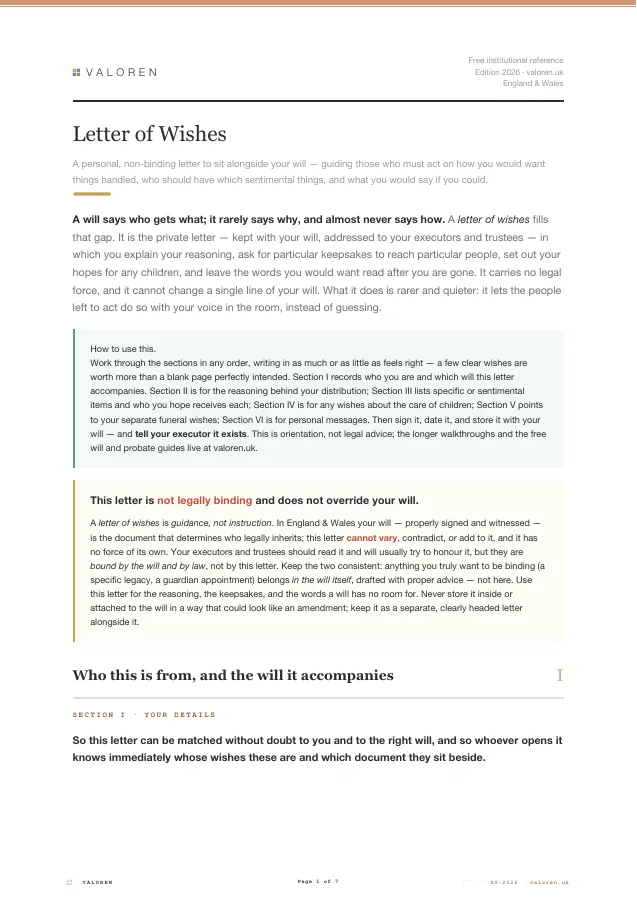
A legacy letter is a personal letter — not a legal document — written to the people you love, to be read after you're gone. It carries your voice, not your instructions.

Most people write one and lose it. A note in an email drafts folder, a card in a drawer nobody else knows about — found by chance, or not at all, years later.

This page covers: what a legacy letter actually is · what to put in one · the formats you can use · where it needs to live so it's found when it matters.

§1

What actually goes in one

There's no template for this — but the people who finish one usually cover the same ground. A few short paragraphs, said plainly, land harder than a polished essay.

The values you lived by

What mattered to you — shown through a story or two, not a list of rules. A memory that explains one is worth more than the rule itself.

What you're grateful for

Name the people and the moments, plainly. This is usually the part a legacy letter is remembered for.

One piece of practical advice

A single thing you'd want them to carry — said once, said clearly. Not a lecture, a line they can return to.

Keep it short

One page beats ten. Brief is what actually gets read — and read again, years later.

§2

Where it needs to live

Don't attach it to your will. Once probate is granted, your will becomes a public record at the Probate Registry — and anything filed with it can become public too. A legacy letter is personal correspondence, not a legal instruction, and it belongs somewhere else.

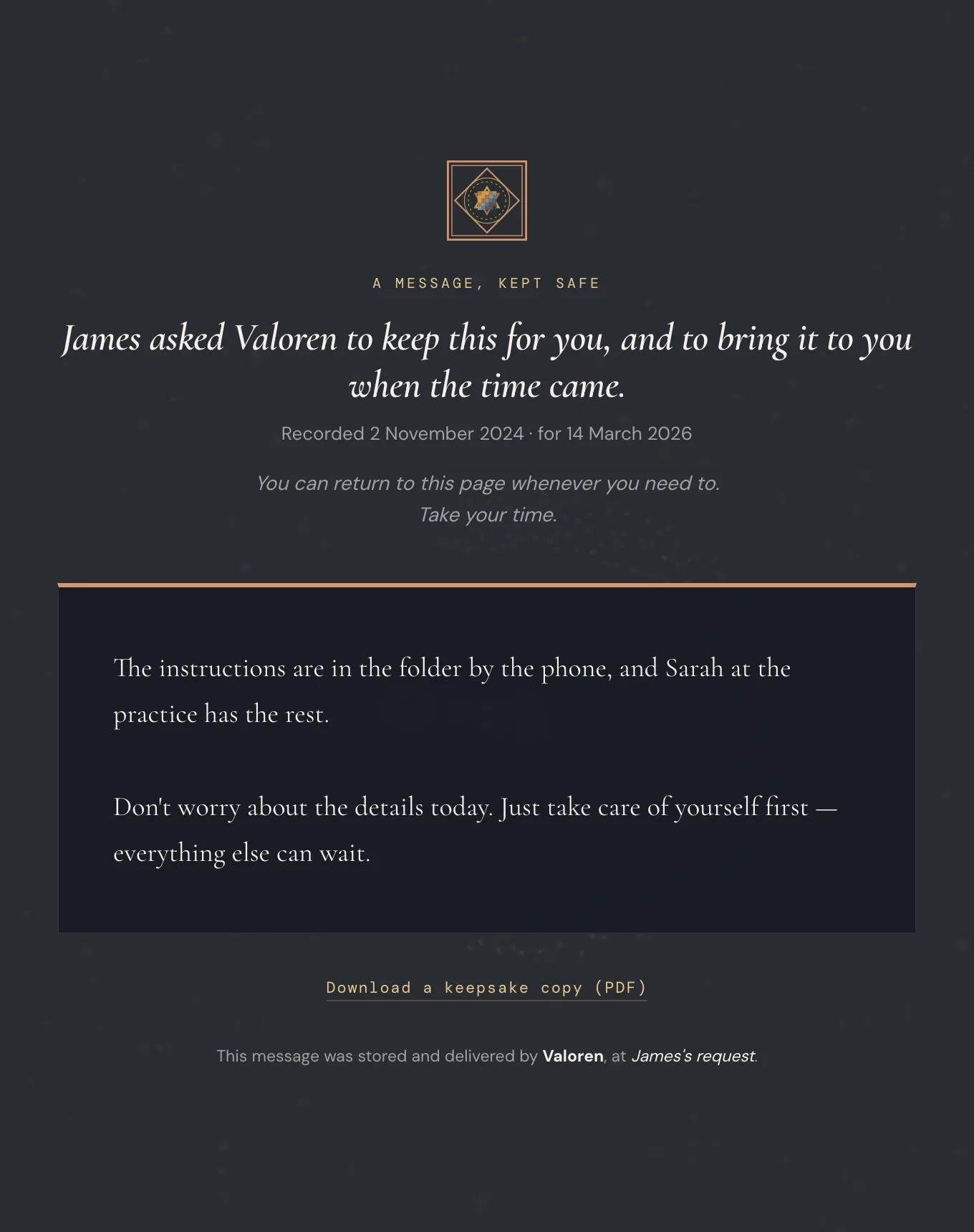
Today, that "somewhere else" can be a sealed message — held with your records and released through the same handover, to the person you name. Not on a public register. Not in a drawer only you know about.

written 2 Nov 2024·held sealed·released when it's time
held until it's time
A legacy letter says what only you could say — held with your records, released when it's time, to the person you name.
§3

Write it, say it, or both

A legacy letter doesn't have to be written at all. Some things land better spoken than typed — and a sealed message can hold either, kept exactly as it was given.

Written

The classic form — typed or handwritten and photographed, kept as the words you chose.

Spoken

Recorded as audio or video, kept exactly as spoken — never rewritten, never smoothed into someone else's sentences.

With enclosures

A photograph, a document, a keepsake — travelling alongside the letter as one sealed bundle, not a separate thing to lose.

Figure watch

The figures on this page change.

Court fees rise, thresholds move, deadlines shift.

Every figure on this page is dated and carries its source, and we re-check them against those sources. Leave an email and it reaches us directly.

Send this to Valoren. It reaches a real person.

It reaches a real person · Privacy
The Household Continuity Dossier · £195 yr 1 → £99/year

Sealed, scheduled and time-capsule messages — unlimited, held with the rest of your records

Every legacy letter you write or record lives inside the same system as your will, your Trusted Persons and your other 33 records — one handover, not a separate thing to remember.

See what's included
FAQ

Common questions

01Is a legacy letter legally binding?

No. A legacy letter carries no legal weight of its own — it doesn't appoint an executor, doesn't decide who gets what, and doesn't override your will. That's what a will and a letter of wishes are for. A legacy letter is personal: your voice, not your instructions.

02What's the difference between a legacy letter and a letter of wishes?

A letter of wishes gives context to decisions — guardianship, funeral preferences, how you'd like an executor to use their discretion. A legacy letter isn't about decisions at all — it's what you want someone to hear from you: gratitude, a memory, an "I'm proud of you." Many people write both; they do different jobs.

03Should I attach my legacy letter to my will?

Better not to. Once probate is granted, a will becomes a public record at the Probate Registry — and anything filed with it can become public too. A legacy letter is personal correspondence; keep it separate from the will, held with your other records instead.

04Can I write more than one legacy letter?

Yes — one letter to the whole family, or a separate one for each person, written whenever you have something to say. There's no limit, and no single "right" way to divide it.

05Does it have to be written — can I record it instead?

Either, or both. A sealed message can be written, or recorded as audio or video, kept exactly as spoken — with enclosures, such as a photograph, travelling alongside it as part of the same sealed bundle.

06How do I make sure it's actually found when it's needed?

Keep it with the rest of your records, not in a drawer only you know about. A sealed message held inside The Household Continuity Dossier is released through the same handover as everything else — to the person you name, at the point it's needed.

Plate R · Related

If this was useful, you might also need —

Part of a working library79form walkthroughs90+free guidesevery calculator & checker

We use first-party analytics only — no advertising or tracking third parties — to see which pages actually help people. You can keep that off. Anonymous error reports go to our error-monitoring processor so we can fix what breaks. Privacy