Skip to content
United States editionIn your inbox within a minute30-day money-back promise
The End of Life Plannerby Valoren

General information · not a substitute for the advice of an attorney.

Free · general informationUnited States

What to do when someone dies

The first hours, the first weeks and what follows them, in the order they usually come, each in the words of the body that publishes it. What each state settles for itself, probate, a small estate and the death certificate, has its own pages below.

  • Every fact dated, in the official words
  • Each state’s own law

Every quotation checked November 10, 2026How we check

The free first-week checklist

Pages taken from the planner, by email: who to phone first, and a blank records sheet.

We use your email address to send the checklist and those emails, and for nothing else. We do not sell it. We first send one email asking you to confirm your address. Privacy notice

The phone page, free

One sheet: where the passcode is kept, your Apple Legacy Contact, and the recovery codes. It is the planner’s first section, cut short.

Download the phone page (PDF) →

What to do, and when

What to do after a death, as one list, in the order it usually comes. Tick each step when it is done: your ticks are kept in this browser only and never sent anywhere. Under each step is the body it comes from, the date we checked it, and a link to its own words.

0 of 42 done

The first day

  • “What to do after someone dies depends on where the person died.”
    National Institute on Aging (www.nia.nih.gov/health/grief-and-mourning/what-do-after-someone-dies) · checked November 10, 2026 · See §1
  • “As soon as possible, the death must be officially pronounced by someone in authority like a doctor in a hospital or nursing facility or a hospice nurse.”
    National Institute on Aging (www.nia.nih.gov/health/grief-and-mourning/what-do-after-someone-dies) · checked November 10, 2026 · See §1
  • “If the person was in hospice, a plan for what happens after death will likely already be in place.”
    National Institute on Aging (www.nia.nih.gov/health/grief-and-mourning/what-do-after-someone-dies) · checked November 10, 2026 · See §1
  • “If the person wasn’t in hospice, talk with the doctor, local medical examiner (coroner), local health department, or a funeral home representative about how to proceed.”
    National Institute on Aging (www.nia.nih.gov/health/grief-and-mourning/what-do-after-someone-dies) · checked November 10, 2026 · See §1
  • “If someone dies at home, there is no need to move the body right away.”
    National Institute on Aging (www.nia.nih.gov/health/grief-and-mourning/what-do-after-someone-dies) · checked November 10, 2026 · See §2
  • “Some families want time to sit quietly with the body, console each other, and maybe share memories.”
    National Institute on Aging (www.nia.nih.gov/health/grief-and-mourning/what-do-after-someone-dies) · checked November 10, 2026 · See §2
  • “Some States list this information on the driver’s license. If not, the decision has to be made quickly.”
    National Institute on Aging (www.nia.nih.gov/health/grief-and-mourning/what-do-after-someone-dies) · checked November 10, 2026 · See §1
  • “The doctor may ask if you want an autopsy. This is a medical procedure conducted by a specially trained physician to learn more about what caused the death.”
    National Institute on Aging (www.nia.nih.gov/health/grief-and-mourning/what-do-after-someone-dies) · checked November 10, 2026 · See §1
  • “This can be done by a funeral home or by the family themselves in most states.”
    National Institute on Aging (www.nia.nih.gov/health/grief-and-mourning/what-do-after-someone-dies) · checked November 10, 2026 · See §1

The first week

  • “Notify Social Security as soon as possible when someone getting benefits dies.”
    Social Security Administration (www.ssa.gov/faqs/en/questions/KA-02077.html) · checked November 10, 2026 · See §8
  • “If you’re the survivor of a Veteran who has died, or their legal representative, we encourage you to contact us as soon as possible to report the death.”
    Department of Veterans Affairs (www.va.gov/resources/how-to-report-the-death-of-a-veteran-to-va/) · checked November 10, 2026 · See §8
  • “An RRB field office should be notified immediately upon the death of any railroad retirement or survivor annuitant.”
    Railroad Retirement Board (www.rrb.gov/Newsroom/NewsReleases/ReportingEvents) · checked November 10, 2026 · See §8
  • “Prompt reporting of a death is important to avoid overpayment.”
    Defense Finance and Accounting Service (www.dfas.mil/RetiredMilitary/survivors/Retiree-Death/) · checked November 10, 2026 · See §7
  • “Contact the vital records office of the state where the death occurred to learn: How to order a certified copy of a death certificate online, by mail, or in-person”
    USAGov (www.usa.gov/death-certificate) · checked November 10, 2026 · See §3
  • “You will need to know the date and place of death.”
    USAGov (www.usa.gov/death-certificate) · checked November 10, 2026 · See §3
  • “Only certain family members may be able to get a death certificate when someone dies. This includes a spouse, siblings, and children.”
    USAGov (www.usa.gov/death-certificate) · checked November 10, 2026 · See §3
  • “You may only need a photocopy for other tasks, such as canceling a subscription.”
    USAGov (www.usa.gov/death-certificate) · checked November 10, 2026 · See §3
  • “The Funeral Rule requires funeral directors to provide price information on the phone to any caller who asks for it.”
    Federal Trade Commission (consumer.ftc.gov/articles/choosing-funeral-provider) · checked November 10, 2026 · See §5
  • “The funeral home must give you a General Price List (GPL) that is yours to keep.”
    Federal Trade Commission (consumer.ftc.gov/articles/ftc-funeral-rule) · checked November 10, 2026 · See §5
  • “You do not have to accept a package that may include items you do not want.”
    Federal Trade Commission (consumer.ftc.gov/articles/ftc-funeral-rule) · checked November 10, 2026 · See §5
  • “The funeral provider cannot refuse to handle a casket or urn you bought online, at a local casket store, or somewhere else — or charge you a fee to do it.”
    Federal Trade Commission (consumer.ftc.gov/articles/ftc-funeral-rule) · checked November 10, 2026 · See §5
  • “In most cases, refrigeration is an acceptable alternative.”
    Federal Trade Commission (consumer.ftc.gov/articles/ftc-funeral-rule) · checked November 10, 2026 · See §5
  • “No state or local law requires the use of a casket for cremation.”
    Federal Trade Commission (consumer.ftc.gov/articles/ftc-funeral-rule) · checked November 10, 2026 · See §5
  • “Funeral providers who offer direct cremations also must offer to provide an alternative container that can be used in place of a casket.”
    Federal Trade Commission (consumer.ftc.gov/articles/types-funerals) · checked November 10, 2026 · See §5
  • “The Rule does not apply to third-party sellers, such as casket and monument dealers, or to cemeteries that lack an on-site funeral home.”
    Federal Trade Commission (consumer.ftc.gov/articles/ftc-funeral-rule) · checked November 10, 2026 · See §5
  • “Avoid putting too much information in an obituary that identity thieves could use.”
    Internal Revenue Service (www.irs.gov/identity-theft-central/identity-theft-guide-for-individuals) · checked November 10, 2026 · See §6


The first month

  • “Cancel benefits payments and close or transfer accounts.”
    USAGov (www.usa.gov/report-a-death) · checked November 10, 2026 · See §4
  • “When you report the death of a loved one to one of the credit reporting agencies, the other two will be contacted on your behalf.”
    TransUnion (www.transunion.com/blog/credit-advice/reporting-a-death-to-tu) · checked November 10, 2026 · See §4
  • “Send credit bureaus a copy of the death certificate. Have them put a “deceased alert” on credit reports.”
    Internal Revenue Service (www.irs.gov/identity-theft-central/identity-theft-guide-for-individuals) · checked November 10, 2026 · See §6
  • “After loved ones pass, you can stop mail from being sent to their addresses.”
    U.S. Postal Service (www.usps.com/manage/mail-for-deceased.htm) · checked November 10, 2026 · See §4
  • “The ANA provides a Deceased Do Not Contact List (DDNC) to assist family members, friends and caretakers seeking to remove the names of deceased individuals from commercial marketing lists.”
    Association of National Advertisers (www.ims-dm.com/cgi/ddnc.php) · checked November 10, 2026 · See §4
  • “Some scammers check obituaries and other legal notices, and then contact relatives of the deceased posing as debt collectors.”
    Consumer Financial Protection Bureau (www.consumerfinance.gov/ask-cfpb/is-it-a-scam-if-a-debt-collector-calls-me-after-seeing-my-relatives-obituary-en-1483/) · checked November 10, 2026 · See §6
  • “Never provide your Social Security number, birth date, or financial account numbers to anyone unless you know who you're dealing with.”
    Consumer Financial Protection Bureau (www.consumerfinance.gov/ask-cfpb/is-it-a-scam-if-a-debt-collector-calls-me-after-seeing-my-relatives-obituary-en-1483/) · checked November 10, 2026 · See §6
  • “A spouse might get a one-time death benefit payment of $255. If there’s no spouse, some children may be eligible.”
    Social Security Administration (www.ssa.gov/personal-record/when-someone-dies) · checked November 10, 2026 · See §7
  • “You may qualify if you’re the spouse, divorced spouse, child, or dependent parent of someone who worked and paid Social Security taxes before they died.”
    Social Security Administration (www.ssa.gov/benefits/survivors/) · checked November 10, 2026 · See §7
  • “If you qualify, you can get tax-free monetary benefits. The amount you receive depends on the type of survivor you are.”
    Department of Veterans Affairs (www.va.gov/disability/dependency-indemnity-compensation/) · checked November 10, 2026 · See §7
  • “Complete the appropriate Application for Death Benefits (SF 2800 for CSRS or SF 3104 and SF 3104B for FERS)”
    Office of Personnel Management (www.opm.gov/retirement-center/my-annuity-and-benefits/life-events/death/report-of-death/) · checked November 10, 2026 · See §7
  • “The RRB will also determine whether any survivor benefits due are payable by the RRB or SSA.”
    Railroad Retirement Board (www.rrb.gov/Newsroom/NewsReleases/ReportingEvents) · checked November 10, 2026 · See §7

The months after

  • “A final return for a decedent who was a calendar year taxpayer is generally due on April 15 following the year of death”
    Internal Revenue Service (www.irs.gov/publications/p559) · checked November 10, 2026 · See §8
  • “For calendar year estates and trusts, file Form 1041 and Schedule(s) K-1 on or before April 15 of the following year.”
    Internal Revenue Service (www.irs.gov/individuals/deceased-taxpayers-filing-the-estate-income-tax-return-form-1041) · checked November 10, 2026 · See §8
  • “If Form 706 is required, the return and payment of any tax is due within 9 months after the date of the decedent’s death.”
    Internal Revenue Service (www.irs.gov/publications/p559) · checked November 10, 2026 · See §8
  • “Watch reports for unusual activity.”
    Internal Revenue Service (www.irs.gov/identity-theft-central/identity-theft-guide-for-individuals) · checked November 10, 2026 · See §6

Every quotation on this page is the official body’s own words, as they stood on the day we read them. The date is beside each one.

At a glance

What to do when someone dies

The first hours
What happens first depends on where the death happened.
The first weeks
The first weeks have a shape, and it is slower than it feels.
The death certificate
The death certificate is the paper almost everyone else will ask for.
Who to tell, and in what order
Nobody is told all at once, and nobody has to be.
The funeral, and paying for it
Arranging a funeral is buying something large, fast, while grieving.
Protecting their identity
A person’s identity can be used after their death, and the weeks right after are when it is most exposed.
Benefits for the family
Some money runs toward the family after a death, not just away from it.
The clocks that start at the death
A few things run to a clock that starts on the day of the death.

The first hours

What happens first depends on where the death happened. At home, in a hospital, in a nursing home or under hospice care, different people are already there or already expected, and they know the local steps. The family’s part in those hours is small: to be present, to make the one or two calls that bring the right people, and to let them do what they do. The National Institute on Aging’s own words below walk through those first steps, including the questions that may be asked of you.

What to do after someone dies depends on where the person died.

As soon as possible, the death must be officially pronounced by someone in authority like a doctor in a hospital or nursing facility or a hospice nurse. This person also fills out the forms certifying the cause, time, and place of death.

If the person was in hospice, a plan for what happens after death will likely already be in place. If the person wasn’t in hospice, talk with the doctor, local medical examiner (coroner), local health department, or a funeral home representative about how to proceed.

Arrangements should be made to pick up the body as soon as the family is ready and according to local laws. This can be done by a funeral home or by the family themselves in most states.

The doctor may ask if you want an autopsy. This is a medical procedure conducted by a specially trained physician to learn more about what caused the death.

The person who is dying may have already said that he or she would like to be an organ donor. Some States list this information on the driver’s license. If not, the decision has to be made quickly.

National Institute on Aging · general information · checked November 10, 2026

The first weeks

The first weeks have a shape, and it is slower than it feels. A few things happen in the first hours, because someone has to be told and someone has to come; after that, most of what follows spreads across days and weeks rather than landing at once. One person can carry the sequence of calls, with everyone else told what is needed when it is needed. The National Institute on Aging’s own words below say what there is no rush about, and what the next few weeks hold.

If someone dies at home, there is no need to move the body right away.

Over the next few weeks, you may want to notify a few places about your loved one’s death.

When a loved one passes, some people want to stay in the room with the body; others prefer to leave. Some families want time to sit quietly with the body, console each other, and maybe share memories.

Remember that everyone grieves differently and there is no sole right way to grieve.

National Institute on Aging · general information · checked November 10, 2026

The death certificate

The death certificate is the paper almost everyone else will ask for. The official words below say where certified copies come from, what you will be asked when you order them, who may order them, and when a plain photocopy is enough. Families are often surprised by how many organizations want one, and by how many want a certified copy rather than a copy of a copy, which is why it comes early here, before the telling begins.

Many organizations require a certified copy of the death certificate when someone dies.

Contact the vital records office of the state where the death occurred to learn: How to order a certified copy of a death certificate online, by mail, or in-person (part of a longer sentence)

You will need to know the date and place of death. The state may also ask for other details about the person. This includes how you are related to them, or why you want the certificate.

Only certain family members may be able to get a death certificate when someone dies. This includes a spouse, siblings, and children. But anyone can request them when they become public record.

You may only need a photocopy for other tasks, such as canceling a subscription. Check with the agency or organization handling each account.

USAGov · general information · checked November 10, 2026

An empty armchair with a folded blanket and a cup on the side table

The first weeks have a shape, and it is slower than it feels.

Who to tell, and in what order

Nobody is told all at once, and nobody has to be. A few organizations come first because money or mail keeps moving until they know; the rest can be told at the household’s pace. The official words below cover those that usually come first: who tends to report a death to Social Security, how the credit bureaus hear of it, what the Postal Service offers for the mail, and the list that takes a name off marketing.

Funeral homes generally tell us when someone dies. So, you don’t typically need to report a death to us. If a funeral home isn’t involved or doesn't report the death for some reason, you should call us (part of a longer sentence)

Social Security Administration · general information · checked November 10, 2026

After someone dies, notify the government programs and businesses they used. Cancel benefits payments and close or transfer accounts.

USAGov · general information · checked November 10, 2026

Experian and the other credit reporting agencies (TransUnion and Equifax) are typically notified of a death by the Social Security Administration (SSA) or the deceased person's creditors.

Experian · general information · checked November 10, 2026

Notifying any one of the three credit bureaus -- Equifax, Experian, and TransUnion -- allows the individual's credit report to be updated with a deceased notice, which may help prevent theft of their identity.

Equifax · general information · checked November 10, 2026

When you report the death of a loved one to one of the credit reporting agencies, the other two will be contacted on your behalf.

TransUnion · general information · checked November 10, 2026

After loved ones pass, you can stop mail from being sent to their addresses.

U.S. Postal Service · general information · checked November 10, 2026

The ANA provides a Deceased Do Not Contact List (DDNC) to assist family members, friends and caretakers seeking to remove the names of deceased individuals from commercial marketing lists.

Association of National Advertisers · general information · checked November 10, 2026

The funeral, and paying for it

Arranging a funeral is buying something large, fast, while grieving. Few purchases are made under more pressure or with less comparison, which is why this is worth reading before the first visit to a funeral home rather than after it. The Federal Trade Commission’s own words below set out a buyer’s rights under its Funeral Rule: what you can decline, what you can ask for before you walk in, and where the rule stops.

Buy only the funeral arrangements you want. You have the right to buy separate goods (such as caskets) and services (such as embalming or a memorial service). You do not have to accept a package that may include items you do not want.

Get a written, itemized price list when you visit a funeral home. The funeral home must give you a General Price List (GPL) that is yours to keep. It lists all the items and services the home offers, and the cost of each one.

Federal Trade Commission · general information · checked November 10, 2026

The Funeral Rule requires funeral directors to provide price information on the phone to any caller who asks for it.

Federal Trade Commission · general information · checked November 10, 2026

The funeral provider cannot refuse to handle a casket or urn you bought online, at a local casket store, or somewhere else — or charge you a fee to do it.

No state law requires routine embalming for every death. Some states require embalming or refrigeration if the body is not buried or cremated within a certain time; some states don’t require it at all. In most cases, refrigeration is an acceptable alternative.

No state or local law requires the use of a casket for cremation.

Federal Trade Commission · general information · checked November 10, 2026

Funeral providers who offer direct cremations also must offer to provide an alternative container that can be used in place of a casket.

Federal Trade Commission · general information · checked November 10, 2026

The Rule does not apply to third-party sellers, such as casket and monument dealers, or to cemeteries that lack an on-site funeral home.

Federal Trade Commission · general information · checked November 10, 2026

Protecting their identity

A person’s identity can be used after their death, and the weeks right after are when it is most exposed. An obituary names the dead and the living; a mailbox fills with statements; a phone rings with people who have read the notice. The official words below, from the IRS and the Consumer Financial Protection Bureau, cover the protective steps those bodies describe: the alert with the credit bureaus, what to leave out of an obituary, and how to treat a caller who asks for more.

Send credit bureaus a copy of the death certificate. Have them put a “deceased alert” on credit reports. Watch reports for unusual activity.

Avoid putting too much information in an obituary that identity thieves could use.

Internal Revenue Service · general information · checked November 10, 2026

Some scammers check obituaries and other legal notices, and then contact relatives of the deceased posing as debt collectors. These scam artists can use your personal information to help them commit identity theft or other types of fraud.

Avoid giving anyone your personal information. Never provide your Social Security number, birth date, or financial account numbers to anyone unless you know who you're dealing with.

Consumer Financial Protection Bureau · general information · checked November 10, 2026

Benefits for the family

Some money runs toward the family after a death, not just away from it. Social Security’s own words below cover the payment it describes for a spouse or child, the monthly benefits for survivors, and who it says may qualify; the words of the Office of Personnel Management, the military’s pay office and the Railroad Retirement Board cover what each asks of a survivor when the person had a federal, military or railroad pension.

A spouse might get a one-time death benefit payment of $255. If there’s no spouse, some children may be eligible.

Social Security Administration · general information · checked November 10, 2026

Survivor benefits provide monthly payments to eligible family members of people who worked and paid Social Security taxes before they died.

You may qualify if you’re the spouse, divorced spouse, child, or dependent parent of someone who worked and paid Social Security taxes before they died.

Social Security Administration · general information · checked November 10, 2026

If you qualify, you can get tax-free monetary benefits. The amount you receive depends on the type of survivor you are.

Department of Veterans Affairs · general information · checked November 10, 2026

Complete the appropriate Application for Death Benefits (SF 2800 for CSRS or SF 3104 and SF 3104B for FERS) and attach any other forms and/or evidence as the application or circumstances require.

Office of Personnel Management · general information · checked November 10, 2026

Prompt reporting of a death is important to avoid overpayment. Retired pay ends on the date of death of the retiree.

Defense Finance and Accounting Service · general information · checked November 10, 2026

The RRB will also determine whether any survivor benefits due are payable by the RRB or SSA.

Railroad Retirement Board · general information · checked November 10, 2026

The clocks that start at the death

A few things run to a clock that starts on the day of the death. These are the national clocks an official body states in a sentence of its own: when it wants to hear of the death, and when its returns are due. A clock with no official sentence behind it is left off rather than guessed, and the clocks that belong to one state are on that state’s pages below.

Notify Social Security as soon as possible when someone getting benefits dies. In most cases, the funeral director will report the person's death to Social Security.

Social Security Administration · general information · checked November 10, 2026

If you’re the survivor of a Veteran who has died, or their legal representative, we encourage you to contact us as soon as possible to report the death.

Department of Veterans Affairs · general information · checked November 10, 2026

An RRB field office should be notified immediately upon the death of any railroad retirement or survivor annuitant.

Railroad Retirement Board · general information · checked November 10, 2026

If Form 706 is required, the return and payment of any tax is due within 9 months after the date of the decedent’s death.

A final return for a decedent who was a calendar year taxpayer is generally due on April 15 following the year of death, regardless of when during that year death occurred.

Internal Revenue Service · general information · checked November 10, 2026

For calendar year estates and trusts, file Form 1041 and Schedule(s) K-1 on or before April 15 of the following year.

Internal Revenue Service · general information · checked November 10, 2026

Friends on a desert patio at sunset, with a saguaro in the distance
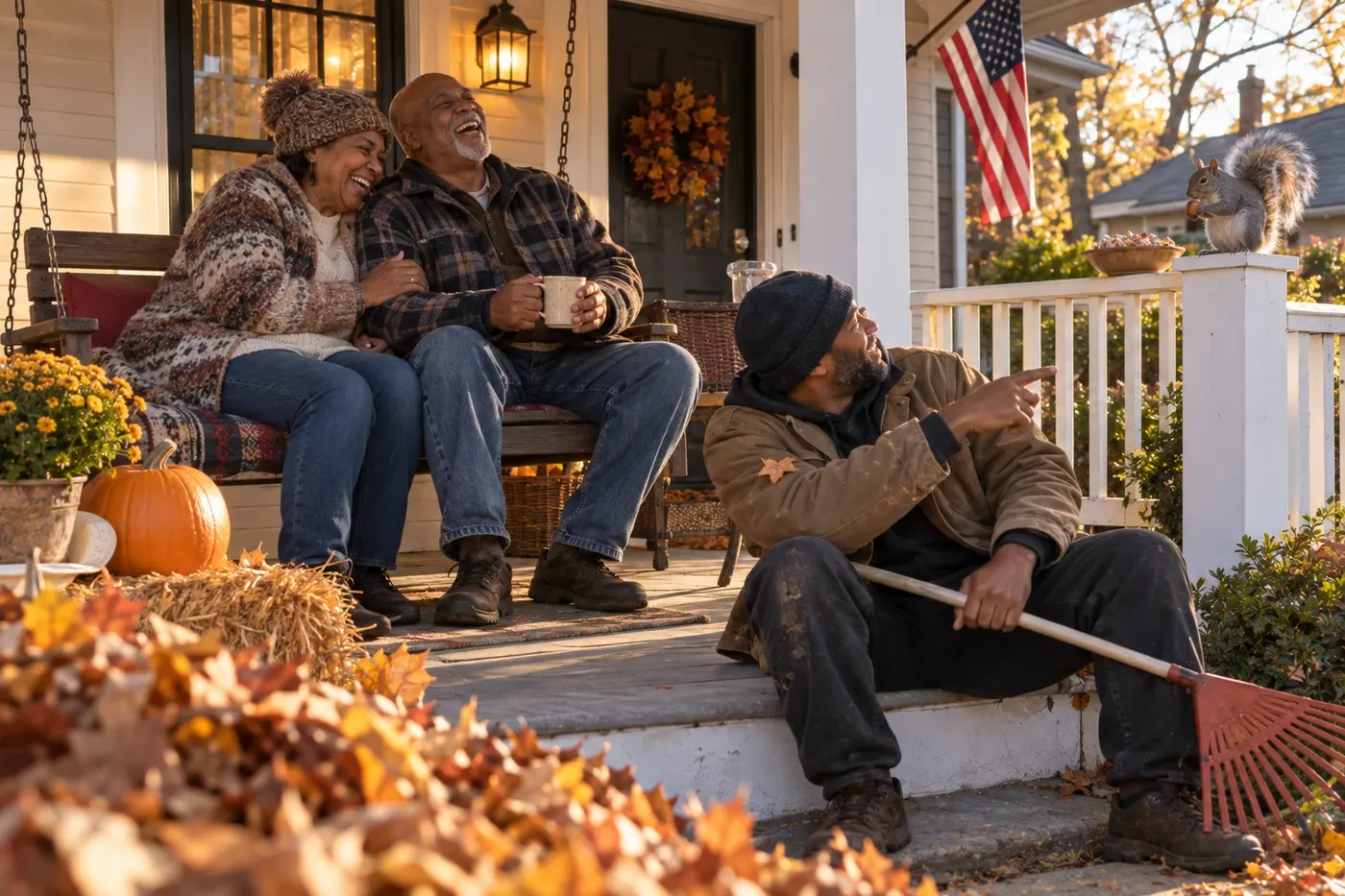
An older couple on a porch swing under a flag, mugs in hand, a neighbor raking leaves below
Friends sharing breakfast at a sunny patio table among citrus trees

For anyone who would rather their family found it all in one place than went looking.

A couple. A parent. An adult child and a parent, doing it together. One sitting starts it; keep it current, and tell someone where it is.

“Apple can’t help remove the passcode lock without erasing the device.”

Apple says so on the page where families send it the death certificate. The first section of the planner is the one that stops that: the passcode, the Legacy Contact and the recovery codes, written down while you still can.

Apple Support, “Request access to a deceased family member’s Apple Account” · read November 2, 2026
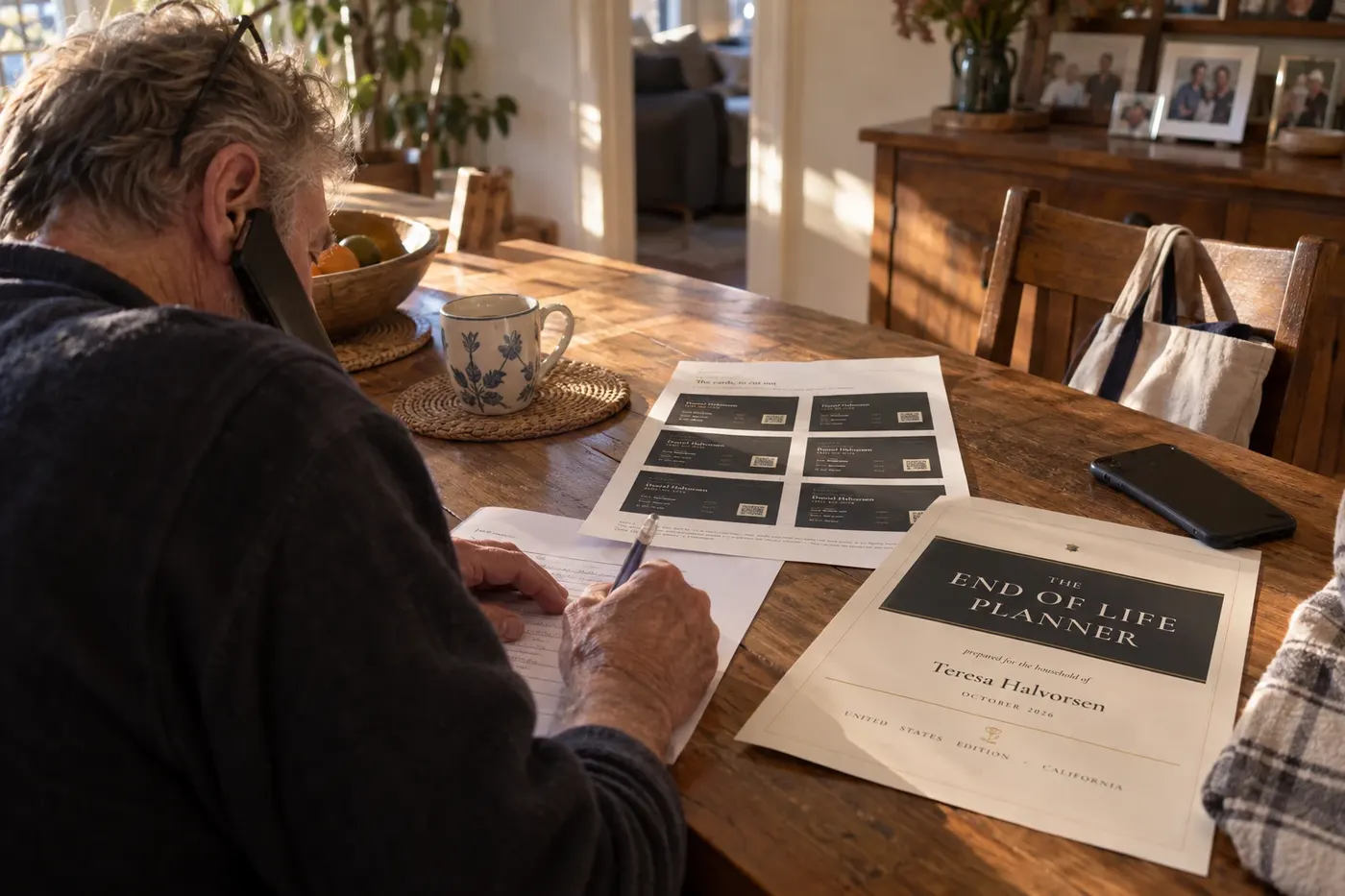
A man on the telephone with the planner's pages open on the table