Skip to content
United States editionIn your inbox within a minute30-day money-back promise
The End of Life Plannerby Valoren

General information · not a substitute for the advice of an attorney.

Free · general informationUnited States

An estate kit: what belongs in one, and The End of Life Planner, one state at a time

An estate kit is the folder your family opens when you die: who to call, where the will and the papers are, and which organizations to tell. This page sets out what belongs in one in the United States, each official fact dated.

Then it shows ours, The End of Life Planner: a printable PDF, one state’s edition at a time.

Every quotation checked October 20, 2026 – November 15, 2026How we check

What an estate kit is

An estate kit is a household’s own record, kept in one place. It says who to call first, where the will and the important papers are, and which banks, insurers and agencies to tell. It is written before it is needed, and opened when it is.

The National Institute on Aging’s own checklist starts in the same place.

“Put your important papers and copies of legal documents in one place.”

NIA · read November 10, 2026

People use other names for the same thing: an estate planning kit, a death binder, a “when I die” folder, a next of kin box. The job does not change.

More than one business sells an estate kit in the United States. This page is about ours, The End of Life Planner, published by Valoren. It is not The Estate Kit, which is sold by HELP SENIOR, LLC, a different company, and Valoren has no connection with that product or the business that sells it.

What an estate kit is not

It is not a will. A kit records that a will exists and where it is kept. It does not make a will, and it does not change one.

It is not a power of attorney or a health care directive. Each of those is a signed paper of its own, and a health care directive is usually made on a state’s own form.

“A power of attorney is a legal document that allows someone else to act on your behalf.”

CFPB · read November 10, 2026

“Many states have their own forms that you can access and complete for free.”

National Institute on Aging · read November 10, 2026

It does not change who an account is paid to. That is set on the account’s own form, and a kit can only record it.

“a TOD plan or other beneficiary document supersedes your will”

FINRA · read November 12, 2026

It is general information, the same for every reader, and it is not a substitute for the advice of an attorney. Who inherits, and whether probate is needed, are for the court, the organization concerned, or an attorney you choose.

What belongs in an estate kit

In the order a family reaches for them. Where a federal agency, a regulator or the company itself says what to write down, its own line is under the row, with the date we read it.

Who to call first

One name and one phone number: the person who knows where the kit is and can make the first calls. Then the people to tell in person.

“Tell someone you know and trust or a lawyer where to find your important papers.”

NIA · read November 10, 2026

Where the papers are kept

Where the will is. Where the other important papers are. Who holds a key or a copy.

“Consider storing paper copies of important documents at home in a fireproof and waterproof box or safe, in a bank safe deposit box, or with a trusted friend or relative.”

Ready.gov · read November 10, 2026

“Be mindful not to use your bank safe deposit box to store anything you might need to access quickly or when the bank is not open.”

FDIC · read November 10, 2026

The will, any trust and the powers of attorney

That each one exists, where the original is, and who is named in it. Not what it says.

“For guidance on where to store your original will, check with an attorney about what is required or recommended based on state law.”

FDIC · read November 10, 2026

“A living trust is ineffective until the person who makes the trust puts their money or property into it.”

Consumer Financial Protection Bureau · read November 10, 2026

Accounts, insurance and what passes outside a will

A list of who holds what: each bank, each retirement account, each insurer, by name. And who is named on each one, because that is set on the account’s own form.

“The owner must designate the beneficiary under procedures established by the plan.”

Internal Revenue Service · read November 10, 2026

“Your will does not affect the distribution of your life insurance proceeds unless the sum goes to your estate”

National Association of Insurance Commissioners · read November 10, 2026

Phones and online accounts

Which phone and which email account matter, and where the passwords are kept. Never the passwords themselves.

“A Legacy Contact is someone you choose to have access to certain data in your Apple Account after your death.”

Apple · read November 10, 2026

“Inactive Account Manager is a way for users to share parts of their account data or notify someone if they’ve been inactive for a certain period of time.”

Google · read November 10, 2026

Funeral wishes

Burial or cremation, the kind of service, and anything already arranged or paid for.

“Put your preferences in writing, give copies to family members and your attorney, and keep a copy in a handy place.”

FTC · read November 10, 2026

Who to tell after a death

The organizations, each with its own way of being told: Social Security, the banks, the insurers, the credit bureaus.

“Funeral homes generally tell us when someone dies.”

Social Security · read November 10, 2026

“Many organizations require a certified copy of the death certificate when someone dies.”

USA.gov · read November 10, 2026

When to read it again

Once a year, and after a move, a marriage, a divorce, a birth or a death.

“It’s important to review your plans at least once each year and when any major life event occurs, like a divorce, move, or major change in your health.”

NIA · read November 10, 2026

What changes from state to state

The household’s own record is the same anywhere in the country. The official side is not. This table shows each state’s own words, where we have read them, with the date.

Three things: where death certificates come from, what the law says happens to a will after a death, and whether we have read a transfer-on-death deed law for the state.

What changes by state: death certificates, the will, transfer-on-death deeds. Each cell is the source’s own words with the date we read it.
StateDeath certificates: the officeThe will after a deathTransfer-on-death deed law
Alabama

“any person having custody of a will of the testator…”

Code of Ala. §43-8-270 · read November 10, 2026

not yet read

Alaska

“a person having custody of a will of the testator…”

AS 13.12.516 · read November 10, 2026
Arizona

“After the death of a testator and on request of an interested person, a person having custody of a will of the testator shall deliver it with reasonable promptness to a person able to secure its probate or, if none is …”

A.R.S. §14-2516 · read November 10, 2026
Arkansas

“A will may be deposited by the person making it, or by some person for him or her, with the circuit court of the county of his or her residence, to be safely kept until delivered or disposed of as provided in this …”

“A beneficiary deed transfers the interest to the designated grantee effective upon the death of the owner”

California

“shall, within 30 days after having knowledge of the death … Deliver the will … to the clerk of the superior court”

Cal. Prob. Code §8200 · read November 15, 2026
Colorado

“The original Will must be filed with the Court.”

JDF 906 · read November 10, 2026

“An owner may transfer an interest in real property effective on the death of the owner by executing a beneficiary deed that contains the words”

Connecticut

“Any person having in his possession any will or codicil shall, forthwith, after he has knowledge of the death of the testator, deliver such will either to the person designated to be the executor or one of the persons …”

Conn. Gen. Stat. §45a-282 · read November 10, 2026

not yet read

Delaware

“Any person, having the custody or possession of any instrument of writing purporting to be a last will and testament and intended to take effect upon the death of the testator therein named, shall produce and deliver …”

12 Del. C. §1301(a) · read November 10, 2026
District of Columbia

“Whoever, having possession of a testamentary instrument, willfully neglects, for the period of 90 days after the death of the testator becomes known to him, to deliver it to the Probate Court, or to the Register of …”

D.C. Code §18-111 · read November 10, 2026

“An individual may transfer property to one or more beneficiaries effective at the transferor’s death by a transfer on death deed.”

D.C. Code §19-604.05 · read November 10, 2026
Florida

“The custodian of a will must deposit the will with the clerk of the court”

Fla. Stat. §732.901 · read November 10, 2026

not yet read

Georgia

“anyone who is in possession of the will of an individual who has died must…”

Carroll County Probate Court (Georgia) · read November 10, 2026

not yet read

Hawaii

“Any individual may deposit with the court the original will and any codicils for safekeeping without probate after the death of the individual who executed the will.”

Haw. Prob. R. 74(a), (c), (d) · read November 10, 2026

not yet read

Idaho

“After the death of the testator, any person having custody of a will of the testator shall deliver it with reasonable promptness to a person able to secure its probate and if none is known, to an appropriate court.”

Idaho Code §15-2-902 · read November 10, 2026

not yet read

Illinois

“Immediately upon the death of the testator any person who has the testator's will in his possession shall file it…”

Indiana

“After the death of a person, the person having custody of the decedent's will: (1) may”

IC 29-1-7-3(a), (c) · read November 10, 2026
Iowa

“After being informed of the death of the testator, the person having custody of the testator’s will shall deliver it to the court having jurisdiction of the testator’s estate.”

Iowa Code §633.285 · read November 10, 2026

not yet read

Kansas

“After the death of a testator the person having custody of the testator's will shall deliver it to the court which has jurisdiction thereof.”

K.S.A. 59-621 · read November 10, 2026
Kentucky

“Any District Court, on being informed that a person has in his custody the will of a testator, may summon him, and, by proper process, compel him to produce it.”

KRS 394.160 · read November 10, 2026

not yet read

Louisiana

“If a person has possession of a document purporting to be the testament of a deceased person, even though the person believes that the document is not the valid testament of the deceased or has doubts concerning the …”

La. C.C.P. art. 2853(A) · read November 10, 2026

not yet read

Maine

“After the death of a testator, a person having custody of a will of the testator shall deliver it with reasonable promptness to a person able to secure its probate or, if no such person is known, to an appropriate court …”

18-C M.R.S. §2-515 · read November 10, 2026
Maryland

“After the death of a testator, a person having custody of the testator’s will shall deliver the will to the register for the county in which administration should be had pursuant to § 5–103 of this article.”

Massachusetts

“A will may be deposited by the testator or the testator's agent with any court for safekeeping, under rules of the court.”

G.L. c. 190B, §2-515 · read November 10, 2026

not yet read

Michigan

“A custodian of a will or codicil or person having possession or care of a will or codicil shall forward it to the court having jurisdiction with reasonable promptness after the death of the testator either by delivering …”

MCL 700.2516 · read November 10, 2026

not yet read

Minnesota

“After the death of a testator and on request of an interested person, a person having custody of a will of the testator shall deliver it with reasonable promptness to an appropriate court.”

Minn. Stat. §524.2-516 · read November 10, 2026

“A deed that conveys or assigns an interest in real property, to a grantee beneficiary and that expressly states that the deed is only effective on the death of one or more of the grantor owners, transfers the interest …”

Minn. Stat. §507.071, subd. 2, subd. 8 · read November 10, 2026
Mississippi

not yet read

Missouri

“After the death of the testator, the person having custody of his will shall deliver it to the probate division of the circuit court which has jurisdiction of the estate or to the probate division of the circuit court …”

RSMo §473.043.1–.3 · read November 10, 2026
Montana

“After the death of a testator and on request of an interested person, a person having custody of a will of the testator shall deliver it with reasonable promptness to a person able to secure its probate and, if none is …”

MCA 72-2-536 · read November 10, 2026
Nebraska

“After the death of a testator and on request of an interested person, any person having custody of a will of the testator is required to deliver it with reasonable promptness to a person able to secure its probate and …”

Neb. Rev. Stat. §30-2356 · read November 10, 2026
Nevada

“Any person having possession of a will shall, within 30 days after knowledge of the death of the person who executed the will, deliver it to the clerk of the district court which has jurisdiction of the case or to the …”

NRS 136.050(1)–(2) · read November 10, 2026
New Hampshire

“Every person having the custody of a will shall, within 30 days after he has knowledge of the decease of the testator, deliver it to the court of probate, or to the person named therein as executor.”

RSA 552:2, 552:4 · read November 10, 2026

not yet read

New Jersey

“The Superior Court shall have jurisdiction to compel discovery as to the existence or whereabouts of any paper purporting to be a will of any decedent who died a resident of the county, which has not been offered for …”

N.J.S.3B:3-29 · read November 3, 2026

not yet read

New Mexico

“Any person having custody of a will shall, as soon as he is informed of the death of the testator, deliver the will to a person able to secure its probate or, if none is known, to an appropriate court.”

NMSA 1978 §45-2-516(A), (C) · read November 10, 2026

“An individual may transfer property to one or more beneficiaries effective at the transferor's death by a transfer on death deed.”

NMSA 1978 §45-6-405 · read November 10, 2026
New York

“The court of any county upon being paid the fees allowed therefor by law shall receive and deposit in the court any will of a domiciliary of the county which any person shall deliver to it for that purpose and shall …”

N.Y. SCPA 2507 · read November 10, 2026
North Carolina

“Any executor named in a will may, at any time after the death of the testator, apply to the clerk of the superior court, having jurisdiction, to have the will admitted to probate.”

N.C. Gen. Stat. §28A-2A-1 · read November 10, 2026

not yet read

North Dakota

“After the death of a testator and on request of an interested person, a person having custody of a will of the testator shall deliver it with reasonable promptness to a person able to secure its probate, and if none is …”

NDCC 30.1-11-02 · read November 10, 2026
Ohio

“A will may be deposited by the testator, or by some person for the testator, in the office of the judge of the probate court in the county in which the testator lives, before or after the death of the testator, and if …”

Ohio Rev. Code §2107.07 · read November 10, 2026
Oklahoma

“Every custodian of a will, within thirty days after receipt of information that the maker thereof is dead, must deliver the same to the district court having jurisdiction of the estate, or to the executor named therein.”

58 O.S. §21 · read November 10, 2026
Oregon

“Shall deliver the will to a court having jurisdiction of the estate of the testator or to a personal representative named in the will within 30 days after the date of receiving information that the testator is dead.”

ORS 112.810(1)(f) · read November 10, 2026
Pennsylvania

“The register, at the request of any party in interest, shall issue a citation directed to any person alleged to have possession or control of a will of a decedent requiring him to show cause why it should not be …”

20 Pa.C.S. §3137 · read November 10, 2026

not yet read

Rhode Island

not yet read

“Every person … who has custody of a will shall, within thirty (30) days…”

R.I. Gen. Laws § 33-7-5(a) · read November 10, 2026

not yet read

South Carolina

“After the death of a testator, a person having custody of a will of the testator shall deliver such will, within thirty days of actual notice or knowledge of the testator's death to the judge of the probate court having …”

S.C. Code §62-2-901(a) · read November 10, 2026

not yet read

South Dakota

“After the death of a testator and on request of an interested person, a person having custody of a will of the testator shall deliver it with reasonable promptness to an appropriate court or to a person able to secure …”

SDCL 29A-2-516 · read November 10, 2026

“Property may be transferred to one or more beneficiaries by a transfer on a death deed and is effective at the transferor's death.”

SDCL 29A-6-403 · read November 10, 2026
Tennessee

not yet read

not yet read

not yet read

Texas

“the person who has custody of the testator's will shall deliver the will to the clerk of the court”

Utah

“After the death of a testator and on request of an interested person, a person having custody of a will of the testator shall deliver it with reasonable promptness to a person able to secure its probate.”

Utah Code §75-2-902 · read November 10, 2026

“An individual may transfer property to one or more named beneficiaries effective at the transferor's death by a transfer on death deed.”

Utah Code §75-6-405 · read November 10, 2026
Vermont

“If a person has the custody of a will, within 30 days after learning of the death of the testator, the custodian shall deliver the will to the Probate Division of the Superior Court where venue lies or to the executor …”

14 V.S.A. §§103, 106 · read November 10, 2026

not yet read

Virginia

“A person or his attorney may, during the person's lifetime, lodge for safekeeping with the clerk of the circuit court serving the jurisdiction where the person resides any will executed by such person.”

Va. Code §64.2-409 · read November 10, 2026
Washington

“Any person having the custody or control of any will shall, within thirty days after he or she shall have received knowledge of the death of the testator, deliver said will to the court having jurisdiction or to the …”

RCW 11.20.010 · read November 10, 2026
West Virginia

“A person having custody of a will shall, within thirty days after the death of the testator is known to him deliver such will to the clerk of the county court having jurisdiction of the probate thereof, or to the …”

W. Va. Code §41-5-1 · read November 10, 2026

“An individual may transfer property to one or more beneficiaries or contingent beneficiaries effective at the transferor's death by a transfer on death deed.”

W. Va. Code §36-12-5 · read November 10, 2026
Wisconsin

“any testator may deposit his or her will with the register in probate”

Wis. Stat. s. 853.09(1), (2) · read November 10, 2026

not yet read

Wyoming

“Every custodian of a will, within ten (10) days after receipt of information that the maker thereof is dead, shall deliver the same to the clerk of the district court having jurisdiction of the estate or to the executor …”

W.S. 2-6-119(a) · read November 10, 2026

"Not yet read" means we have not read that state's own rule. It does not mean the state has no rule.

Is an estate kit worth paying for?

A list on paper does much of the job, and a list is free. Start there if you are not sure.

What is free

The National Institute on Aging publishes its own checklist. On this site the death binder checklist, the estate planning checklist and the next of kin box sheet are free to print. They are linked at the foot of this page.

What a paid kit adds

The assembling. Ours puts the records sheets, the list of who to tell, the blank letters and one state’s own sheet in one file, in the order your family would reach for them, with every fact dated.

Who ours does not suit

It is a PDF to print at home, not a bound book and not a box of folders. It makes no will and no signed paper of any kind. If you want a box for the originals, or a will, something else will fit you better.

The End of Life Planner: an estate kit, one state’s edition at a time

Ours is a printable PDF. You print it on Letter paper, or type into it on a computer, and fill it in yourself.

Each planner is one state’s edition, with that state’s sheet and nothing from another state.

  • Phones and accounts. Where the passcode is kept, who your Apple Legacy Contact is, and where the recovery codes are. Apple can’t unlock a phone for your family, so the way in is written down beforehand.
  • Records sheets. Bank and card accounts, beneficiary designations, insurance, retirement accounts, vehicles, property and how its title is held, the safe-deposit box, and the online accounts your family would need to find. A ruled line to write on by hand, or a field to type into, for each one.
  • Who to tell, and how. The federal agencies, the three credit bureaus, banks, custodians and insurers: how each one says it wants to hear of a death, in its own words, with the date we read its page. Some take no letter at all, and the map says which.
  • What passes outside a will. The kinds of thing that usually pass outside a will: beneficiary designations, joint ownership, trusts, and accounts that go on death to a named person. Described in general, so your family knows what to look for and who to ask; never a ruling on yours.
  • Eleven notification letters. Blank letters for a bank or credit union, a card issuer or lender, one credit bureau, a life insurer, a retirement or investment account, an employer, a pension payer, a service provider, a home lender or landlord, another insurer, and the Department of State for a passport. Each reports the death and asks only for what that organization needs.
  • Your state’s sheet. One sheet for the state the planner is bought for: what that state’s own court and records offices publish about probate, small estates and death certificates, each as the body states it, with the date it was checked. Nothing from another state.
  • The cards. Cut-outs with the first-call person’s name and number: one for a wallet, one for the spot by the phone.

You fill it in yourself, a sheet at a time, by hand or on screen, and change it whenever something changes. Once printed it needs nothing from us: no login, no subscription, no renewal.

It is not a will, and it decides nothing for you.

US$45

On sale now in every state and the District of Columbia.

FAQ

Common questions

A household’s own record, kept in one place: who to call first, where the will and the papers are, and which organizations to tell.

“Put your important papers and copies of legal documents in one place.”

NIA · read November 10, 2026

No. A will kit is for making a will. An estate kit records that a will exists and where it is kept. Ours makes no will.

Who to call first. Where the papers are kept. The will, any trust and the powers of attorney. Accounts, insurance and what passes outside a will. Phones and online accounts. Funeral wishes. Who to tell after a death. When to read it again. The list above takes each in turn, with the official line beside it.

There are free lists. On this site the death binder checklist, the estate planning checklist and the next of kin box sheet are free to print. The End of Life Planner itself is paid: US$45, once.

A 30-day money-back promise: within 30 days of the day the planner is emailed, say it is not right or not wanted and the price is refunded.

Two PDF files, emailed straight after payment: your state’s planner with the eleven blank letters inside it, laid out to print on Letter paper, and the guide. The email links to your own private page with every other copy: to type into, and in large print.

Your own record is the same in any state. The offices, the courts and the rules are not. The table above gives each state’s own words, and each planner is one state’s edition.

Ours is a PDF. You print it at home on Letter paper, or type into it on a computer. It is not a bound book, and it is not a box of folders.

No. It is general information, the same for every reader in a state, and it is not a substitute for the advice of an attorney.

This page is about preparing ahead. If you are dealing with an estate now, start with the free pages on what to do when someone dies and the executor checklist. Both are linked below.

For anyone who would rather their family found it all in one place than went looking.

A couple. A parent. An adult child and a parent, doing it together. One sitting starts it; keep it current, and tell someone where it is.

“Apple can’t help remove the passcode lock without erasing the device.”

Apple says so on the page where families send it the death certificate. The first section of the planner is the one that stops that: the passcode, the Legacy Contact and the recovery codes, written down while you still can.

Apple Support, “Request access to a deceased family member’s Apple Account” · read November 2, 2026
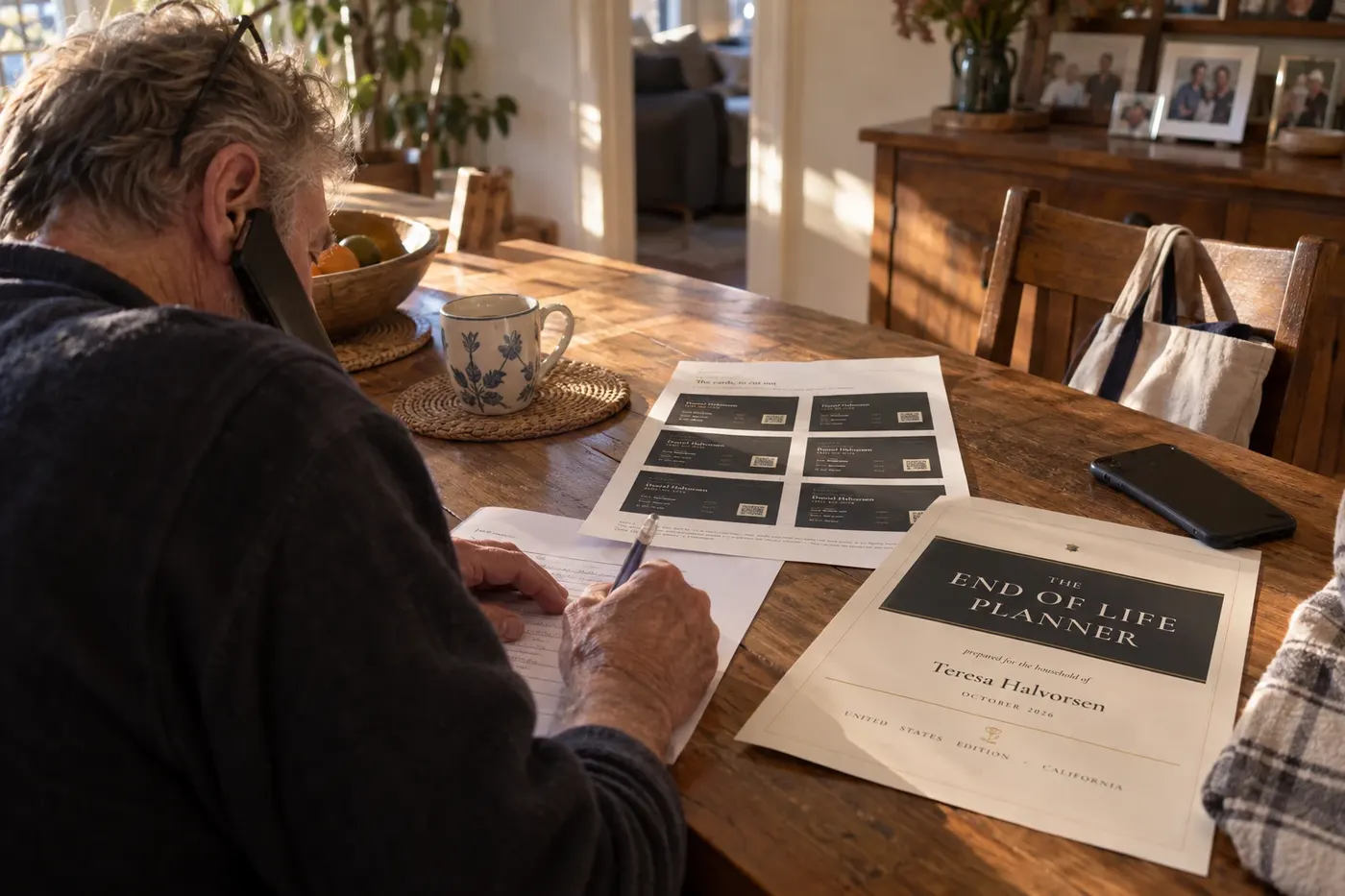
A man on the telephone with the planner's pages open on the table