Skip to content
California editionIn your inbox within a minute30-day money-back promise
The End of Life Plannerby Valoren

General information · not a substitute for the advice of an attorney.

Free · general informationCalifornia

What to do when someone dies in California

The first days, the first two weeks, the first month and the months after, in the order they usually come. Every deadline, fee and limit on this page is the official body's own sentence, California's or a federal agency's, quoted with the date we read it.

Nothing here decides what a particular family must do. That belongs to the office named, the court, or an attorney in California.

Start with the first three days
  • Every fact dated, in the official words
  • Each state’s own law

Every quotation checked November 10, 2026 – November 15, 2026How we check

Wondering whether the estate needs probate? The court's own check Need certified copies of the death certificate? The fee, and how many

Your planner for California is ready. US$45 once, printed at home.

Order the planner · US$45

The free first-week checklist

Pages taken from the planner, by email: who to phone first, and a blank records sheet.

We use your email address to send the checklist and those emails, and for nothing else. We do not sell it. We first send one email asking you to confirm your address. Privacy notice

The phone page, free

One sheet: where the passcode is kept, your Apple Legacy Contact, and the recovery codes. It is the planner’s first section, cut short.

Download the phone page (PDF) →
From the death, or from the day someone learns of it

California's clocks after a death

The doctor completes the medical part of the death certificate
15
hours
eight
calendar days
The death is registered, before any burial or cremation
Whoever holds the will delivers it to the court
30
days
30
days
If the estate needs probate, the executor named in the will asks the court to start it, or may lose the right
A small estate's personal property can be collected with an affidavit, without probate
40
days
60
days
If there is a living trust, its trustee tells the family
A home that passed outside probate is reported to the county assessor
150
days
From the day letters are issued, if the estate goes to probate
If the person had Medi-Cal, the estate tells the state's health care department
90
days
Four
months
The earliest that creditors' time to claim can end, and the inventory is due
The estate is closed, or the court is told why not
one
year

California's clocks after a death

Most of what happens after a death runs on a few dates the law sets. Here is each one, in the order it falls, with the words that set it. The clocks in the second row only start if the estate goes to probate: they run from the day the court issues letters, not from the death.

California's clocks after a death: when each falls, what it is for, and the official words.
WhenWhat it is forThe official words
15 hours

The doctor completes the medical part of the death certificate

“(a) The medical and health section data and the physician's, nurse practitioner's, or coroner's certification shall be completed by the attending physician or nurse practitioner within 15 hours after the death or by the coroner within three days after examination of the body.”

Cal. Health & Safety Code §102800 · read November 15, 2026
eight calendar days

The death is registered, before any burial or cremation

“Each death shall be registered with the local registrar of births and deaths in the district in which the death was officially pronounced or the body was found, within eight calendar days after death and prior to any disposition of the human remains.”

Cal. Health & Safety Code §102775 · read November 10, 2026
30 days

Whoever holds the will delivers it to the court

“(a) Unless a petition for probate of the will is earlier filed, the custodian of a will shall, within 30 days after having knowledge of the death of the testator, do both of the following:” “(1) Deliver the will, personally or by registered or certified mail, to the clerk of the superior court of the county in which the estate of the decedent may be administered.” “(2) Deliver a copy of the will pursuant to Section 1215 to the person named in the will as executor, if the person’s whereabouts is known to the custodian, or if not, to a person named in the will as a beneficiary, if the person’s whereabouts is known to the custodian.”

Cal. Prob. Code §8200 · read November 15, 2026
30 days

If the estate needs probate, the executor named in the will asks the court to start it, or may lose the right

“Unless good cause for delay is shown, if a person named in a will as executor fails to petition the court for administration of the estate within 30 days after the person has knowledge of the death of the decedent and that the person is named as executor, the person may be held to have waived the right to appointment as personal representative.”

Cal. Prob. Code §8001 · read November 10, 2026
40 days

A small estate's personal property can be collected with an affidavit, without probate

“if 40 days have elapsed since the death of the decedent, the successor of the decedent may, without procuring letters of administration or awaiting probate of the will”

Cal. Prob. Code §13100 · read November 15, 2026
60 days

If there is a living trust, its trustee tells the family

“not later than 60 days following the occurrence of the event requiring service of the notification by trustee”

Cal. Prob. Code §16061.7 · read November 10, 2026
150 days

A home that passed outside probate is reported to the county assessor

“the change in ownership statement or statements shall be filed by the trustee (if the property was held in trust) or the transferee with the county recorder or assessor in each county in which the decedent owned an interest in real property within 150 days after the date of death.”

Cal. Rev. & Tax. Code §480(b) · read November 10, 2026
90 days after letters

If the person had Medi-Cal, the estate tells the state's health care department

“(a) Not later than 90 days after the date letters are first issued to a general personal representative, the general personal representative or estate attorney shall give the Director of the State Department of Health Care Services notice of the decedent’s death … if the general personal representative knows or has reason to believe that the decedent received health care under Chapter 7 (commencing with Section 14000) or Chapter 8 (commencing with Section 14200) of Part 3 of Division 9 of the Welfare and Institutions Code, or was the surviving spouse of a person who received that health care. The director has four months after notice is given in which to file a claim.”

Cal. Prob. Code §9202(a), (c) · read November 10, 2026
Four months after letters

The earliest that creditors' time to claim can end, and the inventory is due

“(a) A creditor shall file a claim before expiration of the later of the following times: (1) Four months after the date letters are first issued to a general personal representative. (2) Sixty days after the date notice of administration is mailed or personally delivered to the creditor.”

Cal. Prob. Code §9100 · read November 10, 2026

“The inventory and appraisal shall be filed within four months after letters are first issued to a general personal representative.”

Cal. Prob. Code §8800(b) · read November 10, 2026
one year after letters

The estate is closed, or the court is told why not

“(a) In an estate for which a federal estate tax return is not required, within one year after the date of issuance of letters.”

Cal. Prob. Code §12200 · read November 10, 2026
9 to 18 months

How long formal probate usually takes

“The entire process typically takes 9 to 18 months and can sometimes take even longer.”

selfhelp.courts.ca.gov · read November 10, 2026

Almost nothing has to be decided in the first hour. These are the things that do come first in California, and the law's own words for the ones it sets.

In a hospital, a care home or under hospice care, the staff know the steps and will call the doctor. At home under hospice, call the hospice nurse first.

Call emergency services. California's coroner looks into these deaths and, where there is an inquiry, signs the death certificate.

“It shall be the duty of the coroner to inquire into and determine the circumstances, manner, and cause of all violent, sudden, or unusual deaths; unattended deaths; deaths where the deceased has not been attended by either a physician or a registered nurse, who is a member of a hospice care interdisciplinary team, … in the 20 days before death”

Cal. Gov. Code §27491 · read November 10, 2026

“(b) If the coroner conducts an inquiry pursuant to this section, the coroner or a deputy shall personally sign the certificate of death.”

Cal. Gov. Code §27491 · read November 10, 2026

The doctor or nurse practitioner who was looking after them completes the medical section. You do not need to arrange it.

“(b) The physician or nurse practitioner shall, within 15 hours after the death, deposit the certificate at the place of death or deliver it to the attending funeral director”

Cal. Health & Safety Code §102800 · read November 15, 2026

California names one person, or one group, who decides, and who answers for the reasonable cost. The order is in the next section.

Who decides the funeral: the order California sets

Give the funeral director the Social Security number. Ask for the price list before you sign anything; the funeral home has to give you one.

“Give the funeral director the deceased's Social Security number so he or she can report the death.”

Social Security Administration · read November 12, 2026

“Get a written, itemized price list when you visit a funeral home. The funeral home must give you a General Price List (GPL) that is yours to keep.”

FTC · read November 10, 2026

The funeral home usually files the death certificate for you. Nothing can be buried or cremated until it is filed and a permit is issued.

“(a) A person shall not dispose of human remains unless both of the following have occurred: (1) There has been obtained and filed with a local registrar a death certificate, … (2) There has been obtained from a local registrar a permit for disposition.”

Cal. Health & Safety Code §103050(a) · read November 10, 2026

Lock up, and keep the keys with one person. Feed the pets, and settle who will take them. Keep the car where it is safe, and do not let anyone drive it on the estate's behalf until you know it is insured. Keep every letter that arrives; throw none of it away.

Do not pay their bills from your own money, close accounts or give anything away yet. Who may do that depends on how each thing was owned, and for a bank account it may need someone the court appoints.

“Bank accounts are private and a personal representative must be appointed to gain access to those records. However, sometimes bank statements are found in the person's items at home.”

selfhelp.courts.ca.gov · read November 10, 2026

At a glance

Who decides the funeral, in California's order

  1. 01An agent under a power of attorney for health care who has the right and duty of disposition under Division 4.7 (commencing with Section 4600) of the Probate Code
  2. 02The competent surviving spouse
  3. 03The sole surviving competent adult child of the decedent or, if there is more than one competent adult child of the decedent, the majority of the surviving competent adult children
  4. 04The surviving competent parent or parents of the decedent
  5. 05The sole surviving competent adult sibling of the decedent or, if there is more than one surviving competent adult sibling of the decedent, the majority of the surviving competent adult siblings
  6. 06The surviving competent adult person or persons respectively in the next degrees of kinship or, if there is more than one surviving competent adult person of the same degree of kinship, the majority of those persons
  7. 07A conservator of the person appointed under Part 3 (commencing with Section 1800) of Division 4 of the Probate Code when the decedent has sufficient assets
  8. 08A conservator of the estate appointed under Part 3 (commencing with Section 1800) of Division 4 of the Probate Code when the decedent has sufficient assets
  9. 09The public administrator when the deceased has sufficient assets
Who has the right to decide the funeral in California, in the order the Health and Safety Code names, in its own words.

Who decides the funeral: the order California sets

Unless the person left written directions of their own, California gives the decision to one person or group, in a fixed order, and the same people answer for the reasonable cost. Among several adult children, or several brothers and sisters, the majority decides; fewer may act if they have tried to tell the others and know of no objection.

“(a) The right to control the disposition of the remains of a deceased person, the location and conditions of interment, and arrangements for funeral goods and services to be provided, unless other directions have been given by the decedent pursuant to Section 7100.1, vests in, and the duty of disposition and the liability for the reasonable cost of disposition of the remains devolves upon, the following in the order named:”

Cal. Health & Safety Code §7100(a) · read November 10, 2026

Who has the right to decide the funeral in California, in the order the Health and Safety Code names, in its own words.
In orderThe law's words
First

“(1) An agent under a power of attorney for health care who has the right and duty of disposition under Division 4.7 (commencing with Section 4600) of the Probate Code, except that the agent is liable for the costs of disposition only in either of the following cases:”

Cal. Health & Safety Code §7100(a) · read November 10, 2026
Then

“(2) The competent surviving spouse.”

Cal. Health & Safety Code §7100(a) · read November 10, 2026
Then

“(3) The sole surviving competent adult child of the decedent or, if there is more than one competent adult child of the decedent, the majority of the surviving competent adult children. However, less than the majority of the surviving competent adult children shall be vested with the rights and duties of this section if they have used reasonable efforts to notify all other surviving competent adult children of their instructions and are not aware of any opposition to those instructions by the majority of all surviving competent adult children.”

Cal. Health & Safety Code §7100(a) · read November 10, 2026
Then

“(4) The surviving competent parent or parents of the decedent. If one of the surviving competent parents is absent, the remaining competent parent shall be vested with the rights and duties of this section after reasonable efforts have been unsuccessful in locating the absent surviving competent parent.”

Cal. Health & Safety Code §7100(a) · read November 10, 2026
Then

“(5) The sole surviving competent adult sibling of the decedent or, if there is more than one surviving competent adult sibling of the decedent, the majority of the surviving competent adult siblings. However, less than the majority of the surviving competent adult siblings shall be vested with the rights and duties of this section if they have used reasonable efforts to notify all other surviving competent adult siblings of their instructions and are not aware of any opposition to those instructions by the majority of all surviving competent adult siblings.”

Cal. Health & Safety Code §7100(a) · read November 10, 2026
Then

“(6) The surviving competent adult person or persons respectively in the next degrees of kinship or, if there is more than one surviving competent adult person of the same degree of kinship, the majority of those persons. Less than the majority of surviving competent adult persons of the same degree of kinship shall be vested with the rights and duties of this section if those persons have used reasonable efforts to notify all other surviving competent adult persons of the same degree of kinship of their instructions and are not aware of any opposition to those instructions by the majority of all surviving competent adult persons of the same degree of kinship.”

Cal. Health & Safety Code §7100(a) · read November 10, 2026
Then

“(7) A conservator of the person appointed under Part 3 (commencing with Section 1800) of Division 4 of the Probate Code when the decedent has sufficient assets.” “(8) A conservator of the estate appointed under Part 3 (commencing with Section 1800) of Division 4 of the Probate Code when the decedent has sufficient assets.”

Cal. Health & Safety Code §7100(a) · read November 10, 2026
Last

“(9) The public administrator when the deceased has sufficient assets.”

Cal. Health & Safety Code §7100(a) · read November 10, 2026

The funeral home can order authorized copies of the death certificate on the family's behalf.

The second week is mostly telling people, and getting the paper that proves the death. Close nothing yet.

Order them from the county where the death was registered; it is often quicker than the state. The fee below is the state's; ask the county for its own before you order.

“VS 112 – Certified Copy of Death Record · $26 per copy”

CDPH Vital Records · read November 11, 2026

“CDPH-VR’s average time to process a certified copy request is 4 to 6 weeks. Because of the large volume of requests processed at CDPH-VR, you can often obtain your certificate more quickly from the county office.”

CDPH Vital Records · read November 10, 2026

An authorized copy can be used to prove who the person was; an informational copy cannot. Close family, the executor and a few others can order the authorized kind. Ask each place which kind it accepts.

Certified copies: what they cost, who can order them, and how many

The funeral home usually tells Social Security. A payment that arrives for the month of the death, or later, has to go back.

“Notify Social Security as soon as possible when someone getting benefits dies. In most cases, the funeral director will report the person's death to Social Security.”

Social Security · read November 10, 2026

“If the deceased was receiving Social Security benefits, you must return the benefits received for the month of death and any later months.” “If the payment was received by direct deposit, contact the bank or other financial institution. Ask them to return any funds received for the month of death or later.”

Social Security Administration · read November 12, 2026

“A spouse might get a one-time death benefit payment of $255. If there’s no spouse, some children may be eligible.”

Social Security · read November 10, 2026

If you lived with them, you can open their mail. To send it to another address, the Post Office wants proof that you are the executor or administrator.

“If you shared a mailing address with someone who has died and continue to receive that mail, you have several options: You may open and manage the deceased's mail as needed.”

U.S. Postal Service · read November 12, 2026

“Provide documented proof that you are the appointed executor or administrator authorized to manage the deceased's mail. (Simply having their death certificate is not enough.)”

U.S. Postal Service · read November 11, 2026

Tell each one of the death and ask what it needs from you. Ask the credit bureaus to flag the record, so nobody opens credit in the person's name.

“Send credit bureaus a copy of the death certificate. Have them put a “deceased alert” on credit reports. Watch reports for unusual activity.”

IRS · read November 10, 2026

If the box was in their name alone, a person with a key can ask the bank to open it before anyone is appointed, with proof of the death and of who they are. Only the will, trust papers and funeral instructions come out, and the will goes to the court.

“(a) This section applies only to a safe deposit box in a financial institution held by the decedent in the decedent’s sole name, or held by the decedent and others where all are deceased.” “(b) A person who has a key to the safe deposit box may, before letters have been issued, obtain access to the safe deposit box only for the purposes specified in this section by providing the financial institution with both of the following:” “(1) Proof of the decedent’s death. Proof shall be provided by a certified copy of the decedent’s death certificate or by a written statement of death from the coroner, treating physician, or hospital or institution where the decedent died.” “(2) Reasonable proof of the identity of the person seeking access.” “(4) Permit the person given access to remove instructions for the disposition of the decedent’s remains, and, after a photocopy is made, to remove the wills and trust instruments.” “(f) Except as provided in subdivision (d), the person given access shall not remove any of the contents of the decedent’s safe deposit box.”

Cal. Prob. Code §331 · read November 10, 2026

Whoever has the original will takes or mails it to the superior court, and sends a copy to the executor it names. The courts call this lodging the will.

“If you find an original will, you must deliver it to the court.” “Delivering a will to the court is called “lodging the will.” You must also send a copy of the will to the executor named in the will. If you cannot find the executor, then send it to a person named in the will as a beneficiary.”

selfhelp.courts.ca.gov · read November 10, 2026

“(b) A custodian of a will who fails to comply with the requirements of this section shall be liable for all damages sustained by any person injured by the failure.”

Cal. Prob. Code §8200 · read November 15, 2026

Tell the Department of Veterans Affairs, which stops payments and can explain what the family may claim, including help with the burial.

“If you’re the survivor of a Veteran who has died, or their legal representative, we encourage you to contact us as soon as possible to report the death.”

VA · read November 10, 2026

“You may be eligible for Veterans burial allowances if you’re paying for the burial and funeral costs and you won’t be reimbursed by any other organization, like another government agency or the Veteran’s employer.”

VA · read November 10, 2026

When a veteran dies

Certified copies: what they cost, who can order them, and how many

We found no California office that says how many copies to order. The honest way to decide is to count the places that keep one, and ask each place whether it will hand a copy back.

The fee and the rules are the Department of Public Health's.

“Effective January 1, 2026, the California Department of Public Health – Vital Records (CDPH-VR) increased vital record fees for certified copies, pursuant to Assembly Bill (AB) 64 (Chapter 662, Statutes of 2025).”

CDPH Vital Records · read November 11, 2026

“A certified authorized copy can be used to establish the identity of the person named on the certificate, whereas a certified informational copy cannot be used to establish identity.”

CDPH Vital Records · read November 10, 2026

“The registrant or a parent, legal guardian, child, grandparent, grandchild, sibling, spouse, or domestic partner of the registrant.” “Any person or agency empowered by statute or appointed by a court to act on behalf of the registrant or the registrant’s estate (Include a copy of the power of attorney or documentation identifying you as executor.)” “Any agent or employee of a funeral establishment who acts within the course and scope of employment and on behalf of persons specified in HSC § 7100 (a) (1)-(8).”

CDPH Vital Records · read November 10, 2026

“To receive an authorized copy of a birth, death, or marriage certificate, you must complete the notarized Sworn Statement included with the application and sign the perjury statement.”

CDPH Vital Records · read November 10, 2026

“California Department of Public Health, Vital Records - MS 5103, P.O. Box 997410, Sacramento, CA 95899-7410”

CDPH Vital Records · read November 11, 2026

Where a death certificate is asked for: the places California's law and the offices themselves name, each in its own words.
Where it goesWhat they say
Each bank or holder paid under the small-estate affidavit

“(a) To collect money, receive tangible personal property, or have evidences of a debt, obligation, interest, right, security, or chose in action transferred under this chapter, an affidavit or a declaration under penalty of perjury under the laws of this state shall be furnished to the holder of the decedent’s property stating all of the following:” “(3) “At least 40 days have elapsed since the death of the decedent, as shown in a certified copy of the decedent’s death certificate attached to this affidavit or declaration.””

Cal. Prob. Code §13101(a) · read November 10, 2026
The bank, to open a safe deposit box in their name alone

“(1) Proof of the decedent’s death. Proof shall be provided by a certified copy of the decedent’s death certificate or by a written statement of death from the coroner, treating physician, or hospital or institution where the decedent died.”

Cal. Prob. Code §331 · read November 10, 2026
The county recorder, for a home held in joint tenancy

“(a) An affidavit of death executed by a person having knowledge of the facts. The affidavit shall include a particular description of the real property and an attested or certified copy of a record of the death made and filed in a designated public office as required by law.”

Cal. Prob. Code §210(a) · read November 10, 2026
The DMV, to move a car to an heir

“Deceased owner: Heir may transfer with death certificate and Affidavit for Transfer without Probate (REG 5) (PDF) (value limits apply).”

California DMV · read November 10, 2026
Social Security, banks, card companies, insurers and pensions

“You will need to purchase a certified copy of the death certificate for tasks such as:” “Notifying the Social Security Administration and other government agencies” “Closing or transferring credit cards and bank accounts” “Claiming a person's life insurance or pension”

USAGov · read November 10, 2026
The credit bureaus

“Send credit bureaus a copy of the death certificate. Have them put a “deceased alert” on credit reports. Watch reports for unusual activity.”

IRS · read November 10, 2026
The mortgage servicer

“In the case of inheritance from someone who has died, that proof might include a copy of the executed will and the death certificate or a letter from the executor of the deceased person’s estate.”

CFPB · read November 10, 2026
Not enough on its own: the Post Office

“Provide documented proof that you are the appointed executor or administrator authorized to manage the deceased's mail. (Simply having their death certificate is not enough.)”

U.S. Postal Service · read November 11, 2026

Add one for each bank, insurer and pension on your list, then a few spare. A copy that comes back can be used again.

Hands sorting stacks of papers on a kitchen table

The small-estate limit in California

$208,850

Died on or after April 1, 2025

Judicial Council form DE-300 · read November 10, 2026

For a death on or after the date the form names. At or below this total, the court says, personal property can be collected with an affidavit instead of probate.

“If the total value of these assets is at the set amount or less and 40 days have passed since the death, you can:” “Transfer personal property using an Affidavit”

selfhelp.courts.ca.gov · read November 10, 2026

Is probate needed? The court's own check

California's courts say it depends on what the person owned, how each thing was owned and what it was worth. A will on its own does not avoid it. Their Self-Help Guide sets the check out in steps: list everything, find out how each thing was owned, then add up only what counts.

“Depending on the amount and type of property the deceased person owned, you may or may not need to go to court to transfer or inherit the property.” “A person's estate may need to go through probate even if they had a will.”

selfhelp.courts.ca.gov · read November 10, 2026

“Make a list of everything the person owned (inventory)” “Identify what type of property each item is” “Find out how the property is owned” “Estimate each item's value and then get the total value”

selfhelp.courts.ca.gov · read November 10, 2026

Leave these out of the total

Tick each one they had. The court says not to count these.

selfhelp.courts.ca.gov · read November 10, 2026

Add these up

selfhelp.courts.ca.gov · read November 10, 2026

Do not take debts off the total.

“The debts or mortgages of the person who died. (You are not allowed to subtract the debts of the person who died.”

selfhelp.courts.ca.gov · read November 10, 2026

Then compare the total with the limit for the date of death

The limits are adjusted from time to time. Use the column for the day the person died.

California's small-estate limits by date of death, from the Judicial Council's form, in its own figures.

The values in the left column apply to property of a decedent who died between April 1, 2022, and March 31, 2025. The values in the right column apply to property of a decedent who died on or after April 1, 2025.

these values will next be adjusted April 1, 2028.

What it applies toDied on or after April 1, 2022 and before April 1, 2025Died on or after April 1, 2025
§§13100/13101 affidavit$184,500$208,850
§13151 primary residence petition$184,500$750,000
§13200 real property of small value$61,500$69,625
§§6602/6609 set-aside$95,325$107,900
§13050(c) wages excluded$18,450$20,875

For a death before the earlier of those dates, the court’s simple-transfer page gives these amounts:

What it applies toDied before April 1, 2022
§§13100/13101 affidavit$166,250
§13151 primary residence petition$166,250
§13200 real property of small value$55,425
§§6602/6609 set-aside$85,900
§13050(c) wages excluded$16,625

California · general information · checked November 10, 2026 · Judicial Council form DE-300

What each route needs

“If the total value of these assets is at the set amount or less and 40 days have passed since the death, you can:” “Transfer personal property using an Affidavit”

selfhelp.courts.ca.gov · read November 10, 2026

“(a) To collect money, receive tangible personal property, or have evidences of a debt, obligation, interest, right, security, or chose in action transferred under this chapter, an affidavit or a declaration under penalty of perjury under the laws of this state shall be furnished to the holder of the decedent’s property stating all of the following:”

Cal. Prob. Code §13101(a) · read November 10, 2026

“Assembly Bill 2016 made two important changes to the law for real property. It raised the maximum value of real property for certain petitions to $750,000. It limited this procedure to the decedent's main home in California. This applies to real property petitions under Probate Code sections 13150–13157.”

selfhelp.courts.ca.gov · read November 12, 2026

“PETITION TO DETERMINE SUCCESSION TO PRIMARY RESIDENCE” “requests a determination that the real property described in item 11 was the decedent's primary residence in California and is property passing to petitioner.”

Judicial Council form DE-310 · read November 12, 2026

“AFFIDAVIT RE REAL PROPERTY OF SMALL VALUE” “2. At least six months have passed since the decedent's death. (Attach a certified copy of the decedent's death certificate.)”

Judicial Council form DE-305 · read November 12, 2026

“If a surviving spouse or domestic partner is legally entitled to all the property, they can file a spousal property petition. This is faster and less complicated than opening probate.”

selfhelp.courts.ca.gov · read November 10, 2026

“SPOUSAL OR DOMESTIC PARTNER PROPERTY PETITION” “determination of property passing to the surviving spouse or surviving registered domestic partner without administration”

Judicial Council form DE-221 · read November 12, 2026

If none of these covers everything, the estate may need formal probate: the next section. If there is a living trust, its trustee has a job of its own.

Formal probate opens a case, looks after the estate, and closes it. These are the steps, in order, in the official words.

Someone, usually the executor named in the will, files the petition in the county where the person lived. Notice goes to the family and in a newspaper, then a judge holds a hearing.

“You file a Petition for Probate (form DE-111) along with other court forms.”

selfhelp.courts.ca.gov · read November 10, 2026

“File the case in the county where the person who died (the decedent) lived.”

selfhelp.courts.ca.gov · read November 10, 2026

“PROBATE FEES · 124 First-filed petition for letters of administration or letters testamentary, … · $ 435*” “* Fees marked with an asterisk will vary in the counties of Riverside, San Bernardino, and San Francisco because of a local surcharge for courthouse construction.”

Statewide Civil Fee Schedule, item 124 · read November 10, 2026

“You must give notice of the hearing to the decedent's family members, and to anyone who may have the right to get some part of the estate.”

selfhelp.courts.ca.gov · read November 10, 2026

“You must arrange for notice to be published in a newspaper of general circulation in the city where the person who died lived.”

selfhelp.courts.ca.gov · read November 10, 2026

An executor who waits may be held to have given up the right to be appointed, unless there is good reason. This matters only if the estate needs probate. Where there is no executor, the law sets who comes first.

“Unless good cause for delay is shown, if a person named in a will as executor fails to petition the court for administration of the estate within 30 days after the person has knowledge of the death of the decedent and that the person is named as executor, the person may be held to have waived the right to appointment as personal representative.”

Cal. Prob. Code §8001 · read November 10, 2026

“The order of priority is any surviving spouse or domestic partner, then a child, then a grandchild, then a parent, and then a sibling.”

selfhelp.courts.ca.gov · read November 10, 2026

At the hearing, the judge appoints the personal representative, who then holds letters: the paper banks and others ask to see.

“At the court date, the judge will appoint a personal representative.”

selfhelp.courts.ca.gov · read November 10, 2026

“When the court appoints you as personal representative of an estate, you become an officer of the court and assume certain duties and obligations.” “When you open a bank account for the estate, the account name must indicate that it is an estate account and not your personal account.”

Judicial Council form DE-147; Prob. Code §8404 · read November 10, 2026

Letters testamentary in California

Debts are paid from the estate. Family usually do not pay them from their own money; the federal regulators name the exceptions, and for California one is a spouse, because it is a community property state.

“You do not have to take responsibility for debts owed by a deceased person.”

Consumer Financial Protection Bureau · read November 12, 2026

“You may be personally responsible for the debt if you” “cosigned the obligation, like a car loan” “are the deceased person’s spouse and live in a community property state, such as California”

Federal Trade Commission · read November 12, 2026

“(a) A creditor shall file a claim before expiration of the later of the following times: (1) Four months after the date letters are first issued to a general personal representative. (2) Sixty days after the date notice of administration is mailed or personally delivered to the creditor.”

Cal. Prob. Code §9100 · read November 10, 2026

Debts after a death

“The inventory and appraisal shall be filed within four months after letters are first issued to a general personal representative.”

Cal. Prob. Code §8800(b) · read November 10, 2026

“The personal representative usually will also need to contact a probate referee to value the nonmonetary (non-cash) assets.”

selfhelp.courts.ca.gov · read November 10, 2026

If the person had Medi-Cal, or was the widow or widower of someone who did, the state has to be told. The Franchise Tax Board is told in every estate.

“(a) Not later than 90 days after the date letters are first issued to a general personal representative, the general personal representative or estate attorney shall give the Director of the State Department of Health Care Services notice of the decedent’s death … if the general personal representative knows or has reason to believe that the decedent received health care under Chapter 7 (commencing with Section 14000) or Chapter 8 (commencing with Section 14200) of Part 3 of Division 9 of the Welfare and Institutions Code, or was the surviving spouse of a person who received that health care. The director has four months after notice is given in which to file a claim.”

Cal. Prob. Code §9202(a), (c) · read November 10, 2026

“(c) (1) Not later than 90 days after the date letters are first issued to a general personal representative, the general personal representative or estate attorney shall give the Franchise Tax Board notice of the administration of the estate.”

Cal. Prob. Code §9202(a), (c) · read November 10, 2026

“File BOE-502-D, Change in Ownership Statement—Death of a Real Property Owner within 150 days after the date of death. If the estate is probated, it must be filed before or at the time the inventory and appraisal are filed with the court clerk.” “Filing BOE-502-D also alerts the filer that if the decedent’s children or grandchildren inherited the property and the transfer qualifies for exclusion from reassessment, an applicable claim form BOE-19-P or BOE-19-G must also be filed.”

BOE Publication 800-9 · read November 10, 2026

“the change in ownership statement or statements shall be filed by the trustee (if the property was held in trust) or the transferee with the county recorder or assessor in each county in which the decedent owned an interest in real property within 150 days after the date of death.”

Cal. Rev. & Tax. Code §480(b) · read November 10, 2026

“Taxes: A final personal income tax return is prepared for the person who died.”

selfhelp.courts.ca.gov · read November 10, 2026

“If you received a gift or inheritance, do not include it in your income.” “However, if the gift or inheritance later produces income, you will need to pay tax on that income.”

FTB · read November 10, 2026

A federal estate tax return is only needed for a very large estate.

“WFTC amends § 2010(c)(3) by increasing the basic exclusion amount to $15,000,000 for calendar year 2026.”

IRS · read November 10, 2026

Taxes after a death

By the date the law sets after letters, the personal representative asks the court to close the estate, or reports why it cannot be closed yet.

“The personal representative shall either petition for an order for final distribution of the estate or make a report of status of administration not later than the following times:” “(a) … within one year after the date of issuance of letters.” “(b) In an estate for which a federal estate tax return is required, within 18 months after the date of issuance of letters.”

Cal. Prob. Code §12200 · read November 10, 2026

“Courts usually require a report a year after the personal representative is appointed.”

selfhelp.courts.ca.gov · read November 10, 2026

“When the personal representative has finished administering the estate and is ready to distribute the remaining assets to beneficiaries, they will file a final report, final account, and petition for final distribution.”

selfhelp.courts.ca.gov · read November 10, 2026

“The entire process typically takes 9 to 18 months and can sometimes take even longer.”

selfhelp.courts.ca.gov · read November 10, 2026

What probate costs in California: the fees the law sets

California sets the executor's fee and the attorney's fee on the same scale: a share of the estate's value, paid from the estate, usually at the end. The scale counts the estate before any mortgage or loan is taken off.

“Fees to administer the estate. The fees to administer an estate are generally set by law as a percentage of the total value of the estate. Fees may be paid from the estate to the personal representative and, if there is one, the personal representative’s attorney. Fees are usually not paid until the end of the entire probate case.”

selfhelp.courts.ca.gov · read November 10, 2026

The fee scale for ordinary services, in the Probate Code's own words. The executor's scale and the attorney's are the same.
Part of the estateThe personal representativeThe attorney
The first part

“(1) Four percent on the first one hundred thousand dollars ($100,000).”

Cal. Prob. Code §10800 · read November 10, 2026

“(1) Four percent on the first one hundred thousand dollars ($100,000).”

Cal. Prob. Code §10810 · read November 10, 2026
The next part

“(2) Three percent on the next one hundred thousand dollars ($100,000).”

Cal. Prob. Code §10800 · read November 10, 2026

“(2) Three percent on the next one hundred thousand dollars ($100,000).”

Cal. Prob. Code §10810 · read November 10, 2026
The part after that

“(3) Two percent on the next eight hundred thousand dollars ($800,000).”

Cal. Prob. Code §10800 · read November 10, 2026

“(3) Two percent on the next eight hundred thousand dollars ($800,000).”

Cal. Prob. Code §10810 · read November 10, 2026
The next part

“(4) One percent on the next nine million dollars ($9,000,000).”

Cal. Prob. Code §10800 · read November 10, 2026

“(4) One percent on the next nine million dollars ($9,000,000).”

Cal. Prob. Code §10810 · read November 10, 2026
The next part

“(5) One-half of one percent on the next fifteen million dollars ($15,000,000).”

Cal. Prob. Code §10800 · read November 10, 2026

“(5) One-half of 1 percent on the next fifteen million dollars ($15,000,000).”

Cal. Prob. Code §10810 · read November 10, 2026
Above that

“(6) For all amounts above twenty-five million dollars ($25,000,000), a reasonable amount to be determined by the court.”

Cal. Prob. Code §10800 · read November 10, 2026

“(6) For all amounts above twenty-five million dollars ($25,000,000), a reasonable amount to be determined by the court.”

Cal. Prob. Code §10810 · read November 10, 2026

The scale is worked on the inventory value, plus gains on sales and money received, less losses on sales, before any mortgage.

“(b) For the purposes of this section, the value of the estate accounted for by the personal representative is the total amount of the appraisal value of property in the inventory, plus gains over the appraisal value on sales, plus receipts, less losses from the appraisal value on sales, without reference to encumbrances or other obligations on estate property.”

Cal. Prob. Code §10800 · read November 10, 2026

Work the scale for an estate

The personal representative's fee on the scale
—
The attorney's fee on the scale
—
Both together
—

This is the scale's arithmetic, worked from the two sections above, and nothing more. The court can allow more for extraordinary work, and the final figure is the court's.

“(a) Subject to the provisions of this part, in addition to the compensation provided by Section 10800, the court may allow additional compensation for extraordinary services by the personal representative in an amount the court determines is just and reasonable.”

Cal. Prob. Code §10801(a) · read November 10, 2026

“(a) Subject to the provisions of this part, in addition to the compensation provided by Section 10810, the court may allow additional compensation for extraordinary services by the attorney for the personal representative in an amount the court determines is just and reasonable.”

Cal. Prob. Code §10811(a) · read November 10, 2026

“The costs of administration are often well over $1,000.00 and can be much more.”

selfhelp.courts.ca.gov · read November 10, 2026

“The personal representative can hire a lawyer if they want.”

selfhelp.courts.ca.gov · read November 10, 2026

“Talk to a lawyer to get specific answers about your situation. You can usually pay the lawyer’s fees from the property in the estate.”

selfhelp.courts.ca.gov · read November 10, 2026

Who to call, and what each one needs

Most of these calls can wait a few days. Each row says who it is, why you would call, and the office's own words on what it needs.

Who to call after a death in California: the office, what for, and its own words.
WhoWhat forIn their own words
Social Security

If the funeral home has not told them, or a payment arrived

“You can call us at 1-800-772-1213 between 8:00 a.m. – 7:00 p.m. local time, Monday through Friday.” “If you’re deaf or hard of hearing and use TTY equipment, you can call our TTY number at 1-800-325-0778.”

Social Security Administration · read November 10, 2026
The county coroner or medical examiner

A sudden or unattended death

“It shall be the duty of the coroner to inquire into and determine the circumstances, manner, and cause of all violent, sudden, or unusual deaths; unattended deaths; deaths where the deceased has not been attended by either a physician or a registered nurse, who is a member of a hospice care interdisciplinary team, … in the 20 days before death”

Cal. Gov. Code §27491 · read November 10, 2026
The county recorder or registrar

Certified copies, in person

“Copies may be obtained in person at the county office where the death was registered.”

CDPH Vital Records · read November 11, 2026
California Department of Public Health, Vital Records

Certified copies by mail

“California Department of Public Health, Vital Records - MS 5103, P.O. Box 997410, Sacramento, CA 95899-7410”

CDPH Vital Records · read November 11, 2026
The superior court's probate clerk

Lodging the will; opening probate

“If you find an original will, you must deliver it to the court.” “Delivering a will to the court is called “lodging the will.” You must also send a copy of the will to the executor named in the will. If you cannot find the executor, then send it to a person named in the will as a beneficiary.”

selfhelp.courts.ca.gov · read November 10, 2026
The DMV

Moving a car to an heir

“Deceased owner: Heir may transfer with death certificate and Affidavit for Transfer without Probate (REG 5) (PDF) (value limits apply).”

California DMV · read November 10, 2026
The county assessor

Reporting a home that changed hands

“File BOE-502-D, Change in Ownership Statement—Death of a Real Property Owner within 150 days after the date of death. If the estate is probated, it must be filed before or at the time the inventory and appraisal are filed with the court clerk.” “Filing BOE-502-D also alerts the filer that if the decedent’s children or grandchildren inherited the property and the transfer qualifies for exclusion from reassessment, an applicable claim form BOE-19-P or BOE-19-G must also be filed.”

BOE Publication 800-9 · read November 10, 2026
Medi-Cal (the Department of Health Care Services)

If the person had Medi-Cal, once letters are issued

“(a) Not later than 90 days after the date letters are first issued to a general personal representative, the general personal representative or estate attorney shall give the Director of the State Department of Health Care Services notice of the decedent’s death … if the general personal representative knows or has reason to believe that the decedent received health care under Chapter 7 (commencing with Section 14000) or Chapter 8 (commencing with Section 14200) of Part 3 of Division 9 of the Welfare and Institutions Code, or was the surviving spouse of a person who received that health care. The director has four months after notice is given in which to file a claim.”

Cal. Prob. Code §9202(a), (c) · read November 10, 2026
The Post Office

Their mail

“Provide documented proof that you are the appointed executor or administrator authorized to manage the deceased's mail. (Simply having their death certificate is not enough.)”

U.S. Postal Service · read November 11, 2026
The credit bureaus

A deceased alert

“Send credit bureaus a copy of the death certificate. Have them put a “deceased alert” on credit reports. Watch reports for unusual activity.”

IRS · read November 10, 2026
The IRS

The final return; acting for the estate

“You may use Form 56 to: Provide notification to the IRS of the creation or termination of a fiduciary relationship under section 6903.”

IRS · read November 11, 2026
The Department of Veterans Affairs

If they served

“If you’re the survivor of a Veteran who has died, or their legal representative, we encourage you to contact us as soon as possible to report the death.”

VA · read November 10, 2026
The funeral home

The price list, and the death certificate

“The Funeral Rule requires funeral directors to provide price information on the phone to any caller who asks for it.”

FTC · read November 10, 2026

The first weeks

The estate: probate in California, its route for a smaller estate, what falls to whoever is settling it, and the accounts that pass outside the will.

The same page for other states

A family on a boat dock in Florida: a grandfather fishing, a girl pointing at a heron
Three generations peeling potatoes at a kitchen table while snow falls outside
An older couple on a porch swing under a flag, mugs in hand, a neighbor raking leaves below
FAQ

Questions people ask about a death in California

By the deadline below, and before any burial or cremation. The funeral home usually files it.

“Each death shall be registered with the local registrar of births and deaths in the district in which the death was officially pronounced or the body was found, within eight calendar days after death and prior to any disposition of the human remains.”

Cal. Health & Safety Code §102775 · read November 10, 2026

The doctor or nurse practitioner who was looking after them, or the coroner.

“(a) The medical and health section data and the physician's, nurse practitioner's, or coroner's certification shall be completed by the attending physician or nurse practitioner within 15 hours after the death or by the coroner within three days after examination of the body.”

Cal. Health & Safety Code §102800 · read November 15, 2026

When a death was sudden, violent or unexplained, or nobody medical had seen the person in the days before.

“It shall be the duty of the coroner to inquire into and determine the circumstances, manner, and cause of all violent, sudden, or unusual deaths; unattended deaths; deaths where the deceased has not been attended by either a physician or a registered nurse, who is a member of a hospice care interdisciplinary team, … in the 20 days before death”

Cal. Gov. Code §27491 · read November 10, 2026

An agent under a health care power of attorney comes first, then the spouse, then the adult children by majority, then the parents.

“(1) An agent under a power of attorney for health care who has the right and duty of disposition under Division 4.7 (commencing with Section 4600) of the Probate Code, except that the agent is liable for the costs of disposition only in either of the following cases:”

Cal. Health & Safety Code §7100(a) · read November 10, 2026

“(2) The competent surviving spouse.”

Cal. Health & Safety Code §7100(a) · read November 10, 2026

“(3) The sole surviving competent adult child of the decedent or, if there is more than one competent adult child of the decedent, the majority of the surviving competent adult children. However, less than the majority of the surviving competent adult children shall be vested with the rights and duties of this section if they have used reasonable efforts to notify all other surviving competent adult children of their instructions and are not aware of any opposition to those instructions by the majority of all surviving competent adult children.”

Cal. Health & Safety Code §7100(a) · read November 10, 2026

No.

“(a) A person shall not dispose of human remains unless both of the following have occurred: (1) There has been obtained and filed with a local registrar a death certificate, … (2) There has been obtained from a local registrar a permit for disposition.”

Cal. Health & Safety Code §103050(a) · read November 10, 2026

This is the state's fee. Ask the county office for its fee before you order.

“VS 112 – Certified Copy of Death Record · $26 per copy”

CDPH Vital Records · read November 11, 2026

Often the county where the death was registered.

“CDPH-VR’s average time to process a certified copy request is 4 to 6 weeks. Because of the large volume of requests processed at CDPH-VR, you can often obtain your certificate more quickly from the county office.”

CDPH Vital Records · read November 10, 2026

“A certified authorized copy can be used to establish the identity of the person named on the certificate, whereas a certified informational copy cannot be used to establish identity.”

CDPH Vital Records · read November 10, 2026

Ask each place which kind it accepts.

Close family, the executor or anyone the court appoints, and the funeral home on the family's behalf, with a sworn statement.

“The registrant or a parent, legal guardian, child, grandparent, grandchild, sibling, spouse, or domestic partner of the registrant.” “Any person or agency empowered by statute or appointed by a court to act on behalf of the registrant or the registrant’s estate (Include a copy of the power of attorney or documentation identifying you as executor.)” “Any agent or employee of a funeral establishment who acts within the course and scope of employment and on behalf of persons specified in HSC § 7100 (a) (1)-(8).”

CDPH Vital Records · read November 10, 2026

“To receive an authorized copy of a birth, death, or marriage certificate, you must complete the notarized Sworn Statement included with the application and sign the perjury statement.”

CDPH Vital Records · read November 10, 2026

We found no California office that gives a number. Count the places that keep one: each bank or holder paid under the small-estate affidavit, the county recorder for a home held in joint tenancy, the DMV for a car, and each insurer and pension. Then add a few spare.

The funeral home usually does.

“Notify Social Security as soon as possible when someone getting benefits dies. In most cases, the funeral director will report the person's death to Social Security.”

Social Security · read November 10, 2026

“If the deceased was receiving Social Security benefits, you must return the benefits received for the month of death and any later months.” “If the payment was received by direct deposit, contact the bank or other financial institution. Ask them to return any funds received for the month of death or later.”

Social Security Administration · read November 12, 2026

Only as the executor or administrator, at a Post Office.

“Provide documented proof that you are the appointed executor or administrator authorized to manage the deceased's mail. (Simply having their death certificate is not enough.)”

U.S. Postal Service · read November 11, 2026

Take it to the superior court, and send a copy to the executor it names.

“(a) Unless a petition for probate of the will is earlier filed, the custodian of a will shall, within 30 days after having knowledge of the death of the testator, do both of the following:” “(1) Deliver the will, personally or by registered or certified mail, to the clerk of the superior court of the county in which the estate of the decedent may be administered.” “(2) Deliver a copy of the will pursuant to Section 1215 to the person named in the will as executor, if the person’s whereabouts is known to the custodian, or if not, to a person named in the will as a beneficiary, if the person’s whereabouts is known to the custodian.”

Cal. Prob. Code §8200 · read November 15, 2026

“If you find an original will, you must deliver it to the court.” “Delivering a will to the court is called “lodging the will.” You must also send a copy of the will to the executor named in the will. If you cannot find the executor, then send it to a person named in the will as a beneficiary.”

selfhelp.courts.ca.gov · read November 10, 2026

It depends on the date of death.

The values in the left column apply to property of a decedent who died between April 1, 2022, and March 31, 2025. The values in the right column apply to property of a decedent who died on or after April 1, 2025.

these values will next be adjusted April 1, 2028.

What it applies toDied on or after April 1, 2022 and before April 1, 2025Died on or after April 1, 2025
§§13100/13101 affidavit$184,500$208,850
§13151 primary residence petition$184,500$750,000
§13200 real property of small value$61,500$69,625
§§6602/6609 set-aside$95,325$107,900
§13050(c) wages excluded$18,450$20,875

For a death before the earlier of those dates, the court’s simple-transfer page gives these amounts:

What it applies toDied before April 1, 2022
§§13100/13101 affidavit$166,250
§13151 primary residence petition$166,250
§13200 real property of small value$55,425
§§6602/6609 set-aside$85,900
§13050(c) wages excluded$16,625

California · general information · checked November 10, 2026 · Judicial Council form DE-300

“if 40 days have elapsed since the death of the decedent, the successor of the decedent may, without procuring letters of administration or awaiting probate of the will”

Cal. Prob. Code §13100 · read November 15, 2026

“Cars, boats, or mobile homes”

selfhelp.courts.ca.gov · read November 10, 2026

“Real property outside of California”

selfhelp.courts.ca.gov · read November 10, 2026

“Property held in trust, including a living trust”

selfhelp.courts.ca.gov · read November 10, 2026

“Real or personal property that the person who died owned with someone else (joint tenancy)”

selfhelp.courts.ca.gov · read November 10, 2026

“Property (community, quasi-community, or separate) that passed directly to the surviving spouse or domestic partner”

selfhelp.courts.ca.gov · read November 10, 2026

“Life insurance, death benefits or other assets not subject to probate that pass directly to the beneficiaries”

selfhelp.courts.ca.gov · read November 10, 2026

“Unpaid salary or other compensation up to the amount listed in Maximum Values for Small Estate Set-Aside & Disposition of Estate Without Administration (form DE-300)”

selfhelp.courts.ca.gov · read November 10, 2026

“Bank accounts owned by multiple persons, including the person who died”

selfhelp.courts.ca.gov · read November 10, 2026

No.

“The debts or mortgages of the person who died. (You are not allowed to subtract the debts of the person who died.”

selfhelp.courts.ca.gov · read November 10, 2026

Their main home in California can, up to a limit, by a petition to the court.

“Assembly Bill 2016 made two important changes to the law for real property. It raised the maximum value of real property for certain petitions to $750,000. It limited this procedure to the decedent's main home in California. This applies to real property petitions under Probate Code sections 13150–13157.”

selfhelp.courts.ca.gov · read November 12, 2026

Often not full probate. A shorter court petition can confirm what passes to them.

“If a surviving spouse or domestic partner is legally entitled to all the property, they can file a spousal property petition. This is faster and less complicated than opening probate.”

selfhelp.courts.ca.gov · read November 10, 2026

The first filing fee, then the newspaper notice and the other costs.

“PROBATE FEES · 124 First-filed petition for letters of administration or letters testamentary, … · $ 435*” “* Fees marked with an asterisk will vary in the counties of Riverside, San Bernardino, and San Francisco because of a local surcharge for courthouse construction.”

Statewide Civil Fee Schedule, item 124 · read November 10, 2026

“The costs of administration are often well over $1,000.00 and can be much more.”

selfhelp.courts.ca.gov · read November 10, 2026

“The entire process typically takes 9 to 18 months and can sometimes take even longer.”

selfhelp.courts.ca.gov · read November 10, 2026

By the same scale in the Probate Code, a share of the estate's value.

“(1) Four percent on the first one hundred thousand dollars ($100,000).”

Cal. Prob. Code §10800 · read November 10, 2026

“(2) Three percent on the next one hundred thousand dollars ($100,000).”

Cal. Prob. Code §10800 · read November 10, 2026

“(3) Two percent on the next eight hundred thousand dollars ($800,000).”

Cal. Prob. Code §10800 · read November 10, 2026

The attorney's scale is the same.

“(1) Four percent on the first one hundred thousand dollars ($100,000).”

Cal. Prob. Code §10810 · read November 10, 2026

No.

“(b) For the purposes of this section, the value of the estate accounted for by the personal representative is the total amount of the appraisal value of property in the inventory, plus gains over the appraisal value on sales, plus receipts, less losses from the appraisal value on sales, without reference to encumbrances or other obligations on estate property.”

Cal. Prob. Code §10800 · read November 10, 2026

Only for extraordinary work, and only if the court allows it.

“(a) Subject to the provisions of this part, in addition to the compensation provided by Section 10800, the court may allow additional compensation for extraordinary services by the personal representative in an amount the court determines is just and reasonable.”

Cal. Prob. Code §10801(a) · read November 10, 2026

“(a) Subject to the provisions of this part, in addition to the compensation provided by Section 10810, the court may allow additional compensation for extraordinary services by the attorney for the personal representative in an amount the court determines is just and reasonable.”

Cal. Prob. Code §10811(a) · read November 10, 2026

“(a) A creditor shall file a claim before expiration of the later of the following times: (1) Four months after the date letters are first issued to a general personal representative. (2) Sixty days after the date notice of administration is mailed or personally delivered to the creditor.”

Cal. Prob. Code §9100 · read November 10, 2026

“The inventory and appraisal shall be filed within four months after letters are first issued to a general personal representative.”

Cal. Prob. Code §8800(b) · read November 10, 2026

The state's health care department, if the person had Medi-Cal or was the widow or widower of someone who did, and the Franchise Tax Board.

“(a) Not later than 90 days after the date letters are first issued to a general personal representative, the general personal representative or estate attorney shall give the Director of the State Department of Health Care Services notice of the decedent’s death … if the general personal representative knows or has reason to believe that the decedent received health care under Chapter 7 (commencing with Section 14000) or Chapter 8 (commencing with Section 14200) of Part 3 of Division 9 of the Welfare and Institutions Code, or was the surviving spouse of a person who received that health care. The director has four months after notice is given in which to file a claim.”

Cal. Prob. Code §9202(a), (c) · read November 10, 2026

“(c) (1) Not later than 90 days after the date letters are first issued to a general personal representative, the general personal representative or estate attorney shall give the Franchise Tax Board notice of the administration of the estate.”

Cal. Prob. Code §9202(a), (c) · read November 10, 2026

A change in ownership statement, with the county assessor.

“File BOE-502-D, Change in Ownership Statement—Death of a Real Property Owner within 150 days after the date of death. If the estate is probated, it must be filed before or at the time the inventory and appraisal are filed with the court clerk.” “Filing BOE-502-D also alerts the filer that if the decedent’s children or grandchildren inherited the property and the transfer qualifies for exclusion from reassessment, an applicable claim form BOE-19-P or BOE-19-G must also be filed.”

BOE Publication 800-9 · read November 10, 2026

“the change in ownership statement or statements shall be filed by the trustee (if the property was held in trust) or the transferee with the county recorder or assessor in each county in which the decedent owned an interest in real property within 150 days after the date of death.”

Cal. Rev. & Tax. Code §480(b) · read November 10, 2026

Not as income, says the Franchise Tax Board.

“If you received a gift or inheritance, do not include it in your income.” “However, if the gift or inheritance later produces income, you will need to pay tax on that income.”

FTB · read November 10, 2026

A federal estate tax return is only needed for a very large estate.

“WFTC amends § 2010(c)(3) by increasing the basic exclusion amount to $15,000,000 for calendar year 2026.”

IRS · read November 10, 2026

Possibly. The Federal Trade Commission names California as a community property state, where a spouse can be.

“You may be personally responsible for the debt if you” “cosigned the obligation, like a car loan” “are the deceased person’s spouse and live in a community property state, such as California”

Federal Trade Commission · read November 12, 2026

A notice to the beneficiaries and heirs.

“not later than 60 days following the occurrence of the event requiring service of the notification by trustee”

Cal. Prob. Code §16061.7 · read November 10, 2026

“Deceased owner: Heir may transfer with death certificate and Affidavit for Transfer without Probate (REG 5) (PDF) (value limits apply).”

California DMV · read November 10, 2026

The court appoints someone, in an order the law sets. This is the order for who runs the estate, not for who inherits.

“The order of priority is any surviving spouse or domestic partner, then a child, then a grandchild, then a parent, and then a sibling.”

selfhelp.courts.ca.gov · read November 10, 2026

“Unless good cause for delay is shown, if a person named in a will as executor fails to petition the court for administration of the estate within 30 days after the person has knowledge of the death of the decedent and that the person is named as executor, the person may be held to have waived the right to appointment as personal representative.”

Cal. Prob. Code §8001 · read November 10, 2026

If it was in their name alone and you have a key, you can ask the bank, with proof of the death and of who you are, to look for the will, trust papers and funeral instructions.

“(a) This section applies only to a safe deposit box in a financial institution held by the decedent in the decedent’s sole name, or held by the decedent and others where all are deceased.” “(b) A person who has a key to the safe deposit box may, before letters have been issued, obtain access to the safe deposit box only for the purposes specified in this section by providing the financial institution with both of the following:” “(1) Proof of the decedent’s death. Proof shall be provided by a certified copy of the decedent’s death certificate or by a written statement of death from the coroner, treating physician, or hospital or institution where the decedent died.” “(2) Reasonable proof of the identity of the person seeking access.” “(4) Permit the person given access to remove instructions for the disposition of the decedent’s remains, and, after a photocopy is made, to remove the wills and trust instruments.” “(f) Except as provided in subdivision (d), the person given access shall not remove any of the contents of the decedent’s safe deposit box.”

Cal. Prob. Code §331 · read November 10, 2026

“A spouse might get a one-time death benefit payment of $255. If there’s no spouse, some children may be eligible.”

Social Security · read November 10, 2026

For anyone who would rather their family found it all in one place than went looking.

A couple. A parent. An adult child and a parent, doing it together. One sitting starts it; keep it current, and tell someone where it is.

“Apple can’t help remove the passcode lock without erasing the device.”

Apple says so on the page where families send it the death certificate. The first section of the planner is the one that stops that: the passcode, the Legacy Contact and the recovery codes, written down while you still can.

Apple Support, “Request access to a deceased family member’s Apple Account” · read November 2, 2026
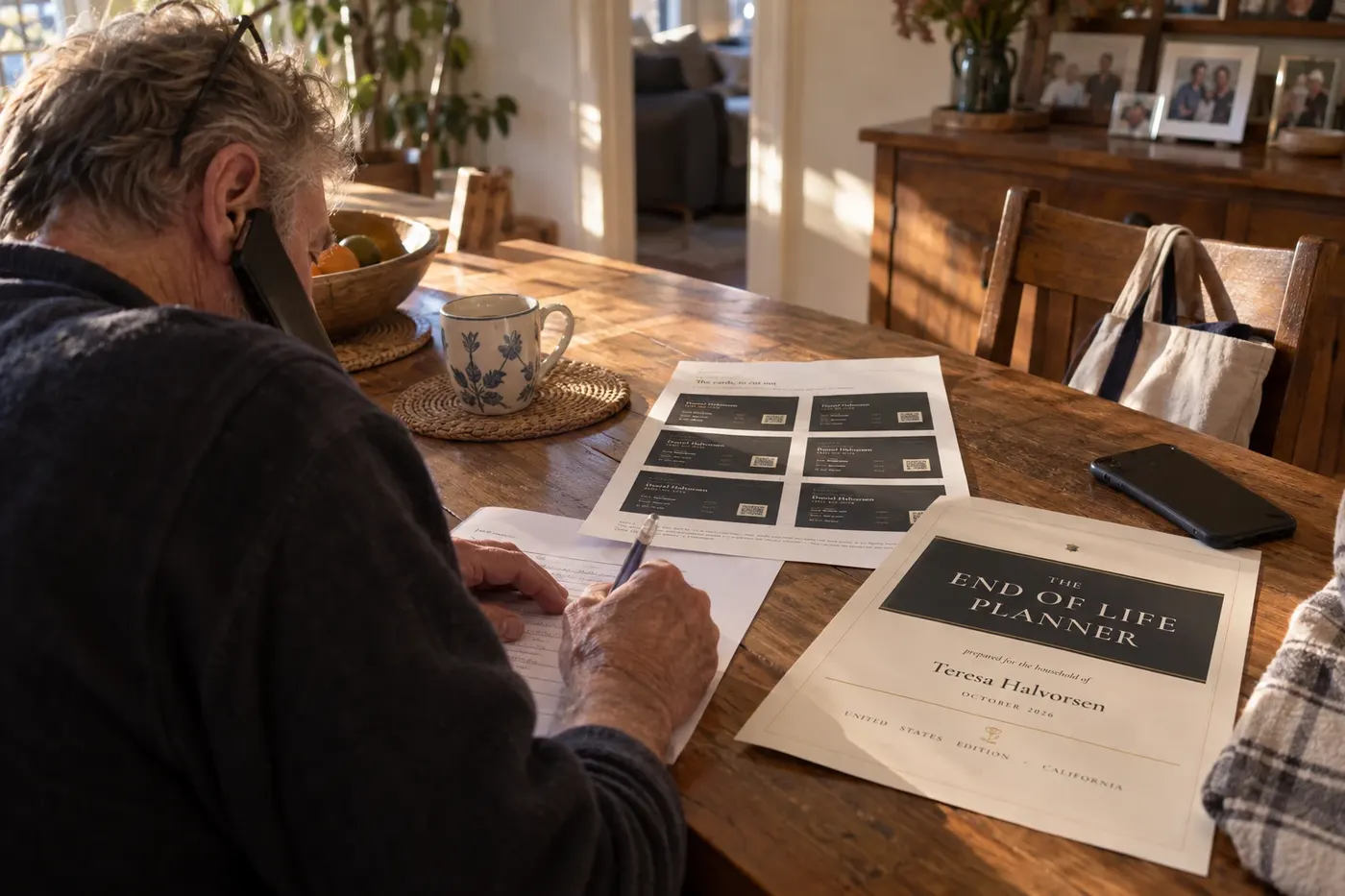
A man on the telephone with the planner's pages open on the table