Skip to content
Texas editionIn your inbox within a minute30-day money-back promise
The End of Life Plannerby Valoren

General information · not a substitute for the advice of an attorney.

Free · general informationTexas

Transfer-on-death deeds in Texas

What Texas’s own law and official pages say about transfer-on-death deeds: what the state calls the instrument, what it must say, how it is signed and recorded, and what happens at the owner’s death. Nothing on this page decides whether a deed suits a particular home or family, or how one should be written. That belongs to an attorney in Texas.

  • Every fact dated, in the official words
  • Each state’s own law

Every quotation checked November 10, 2026 – November 15, 2026How we check

The free first-week checklist

Pages taken from the planner, by email: who to phone first, and a blank records sheet.

We use your email address to send the checklist and those emails, and for nothing else. We do not sell it. We first send one email asking you to confirm your address. Privacy notice

The phone page, free

One sheet: where the passcode is kept, your Apple Legacy Contact, and the recovery codes. It is the planner’s first section, cut short.

Download the phone page (PDF) →

Every quotation on this page is the official body’s own words, as they stood on the day we read them. The date is beside each one.

The act: revoking the deed, capacity, a power of attorney, and its requirements

An individual may transfer the individual's interest in real property to one or more beneficiaries effective at the transferor's death by a transfer on death deed.

A transfer on death deed is revocable regardless of whether the deed or another instrument contains a contrary provision.

(a) The capacity required to make or revoke a transfer on death deed is the same as the capacity required to make a contract. (b) A transfer on death deed may not be created through use of a power of attorney.

To be effective, a transfer on death deed must: (1) except as otherwise provided in Subdivision (2), contain the essential elements and formalities of a recordable deed; (2) state that the transfer of an interest in real property to the designated beneficiary is to occur at the transferor's death; and (3) be recorded before the transferor's death in the deed records in the county clerk's office of the county where the real property is located.

Texas · general information · checked November 15, 2026 · Tex. Est. Code §§114.051–114.055

What the deed does, who may benefit, canceling it, and where it is recorded

A transfer on death deed (TODD) is a legal document that allows a person to transfer ownership of their property after they die. By using a TODD, a person can transfer the property directly without going through probate

Organizations like charities or religious institutions can be beneficiaries.

If a person changes their mind about transferring property to a beneficiary, they can cancel the TODD. The deed must be recorded before the property holder's death. Transfer on death deeds are recorded in the county where the property is located.

Texas · general information · checked November 10, 2026 · Texas State Law Library

Friends sharing breakfast at a sunny patio table among citrus trees
A family on a boat dock in Florida: a grandfather fishing, a girl pointing at a heron
A family roasting marshmallows round a backyard fire pit at night
FAQ

Common questions

A transfer on death deed (TODD) is a legal document that allows a person to transfer ownership of their property after they die. By using a TODD, a person can transfer the property directly without going through probate

Organizations like charities or religious institutions can be beneficiaries.

If a person changes their mind about transferring property to a beneficiary, they can cancel the TODD. The deed must be recorded before the property holder's death. Transfer on death deeds are recorded in the county where the property is located.

Texas · general information · checked November 10, 2026 · Texas State Law Library

An individual may transfer the individual's interest in real property to one or more beneficiaries effective at the transferor's death by a transfer on death deed.

A transfer on death deed is revocable regardless of whether the deed or another instrument contains a contrary provision.

(a) The capacity required to make or revoke a transfer on death deed is the same as the capacity required to make a contract. (b) A transfer on death deed may not be created through use of a power of attorney.

To be effective, a transfer on death deed must: (1) except as otherwise provided in Subdivision (2), contain the essential elements and formalities of a recordable deed; (2) state that the transfer of an interest in real property to the designated beneficiary is to occur at the transferor's death; and (3) be recorded before the transferor's death in the deed records in the county clerk's office of the county where the real property is located.

Texas · general information · checked November 15, 2026 · Tex. Est. Code §§114.051–114.055

A transfer on death deed (TODD) is a legal document that allows a person to transfer ownership of their property after they die. By using a TODD, a person can transfer the property directly without going through probate

Organizations like charities or religious institutions can be beneficiaries.

If a person changes their mind about transferring property to a beneficiary, they can cancel the TODD. The deed must be recorded before the property holder's death. Transfer on death deeds are recorded in the county where the property is located.

Texas · general information · checked November 10, 2026 · Texas State Law Library

An individual may transfer the individual's interest in real property to one or more beneficiaries effective at the transferor's death by a transfer on death deed.

A transfer on death deed is revocable regardless of whether the deed or another instrument contains a contrary provision.

(a) The capacity required to make or revoke a transfer on death deed is the same as the capacity required to make a contract. (b) A transfer on death deed may not be created through use of a power of attorney.

To be effective, a transfer on death deed must: (1) except as otherwise provided in Subdivision (2), contain the essential elements and formalities of a recordable deed; (2) state that the transfer of an interest in real property to the designated beneficiary is to occur at the transferor's death; and (3) be recorded before the transferor's death in the deed records in the county clerk's office of the county where the real property is located.

Texas · general information · checked November 15, 2026 · Tex. Est. Code §§114.051–114.055

A transfer on death deed (TODD) is a legal document that allows a person to transfer ownership of their property after they die. By using a TODD, a person can transfer the property directly without going through probate

Organizations like charities or religious institutions can be beneficiaries.

If a person changes their mind about transferring property to a beneficiary, they can cancel the TODD. The deed must be recorded before the property holder's death. Transfer on death deeds are recorded in the county where the property is located.

Texas · general information · checked November 10, 2026 · Texas State Law Library

An individual may transfer the individual's interest in real property to one or more beneficiaries effective at the transferor's death by a transfer on death deed.

A transfer on death deed is revocable regardless of whether the deed or another instrument contains a contrary provision.

(a) The capacity required to make or revoke a transfer on death deed is the same as the capacity required to make a contract. (b) A transfer on death deed may not be created through use of a power of attorney.

To be effective, a transfer on death deed must: (1) except as otherwise provided in Subdivision (2), contain the essential elements and formalities of a recordable deed; (2) state that the transfer of an interest in real property to the designated beneficiary is to occur at the transferor's death; and (3) be recorded before the transferor's death in the deed records in the county clerk's office of the county where the real property is located.

Texas · general information · checked November 15, 2026 · Tex. Est. Code §§114.051–114.055
For anyone who would rather their family found it all in one place than went looking.

A couple. A parent. An adult child and a parent, doing it together. One sitting starts it; keep it current, and tell someone where it is.

“Apple can’t help remove the passcode lock without erasing the device.”

Apple says so on the page where families send it the death certificate. The first section of the planner is the one that stops that: the passcode, the Legacy Contact and the recovery codes, written down while you still can.

Apple Support, “Request access to a deceased family member’s Apple Account” · read November 2, 2026
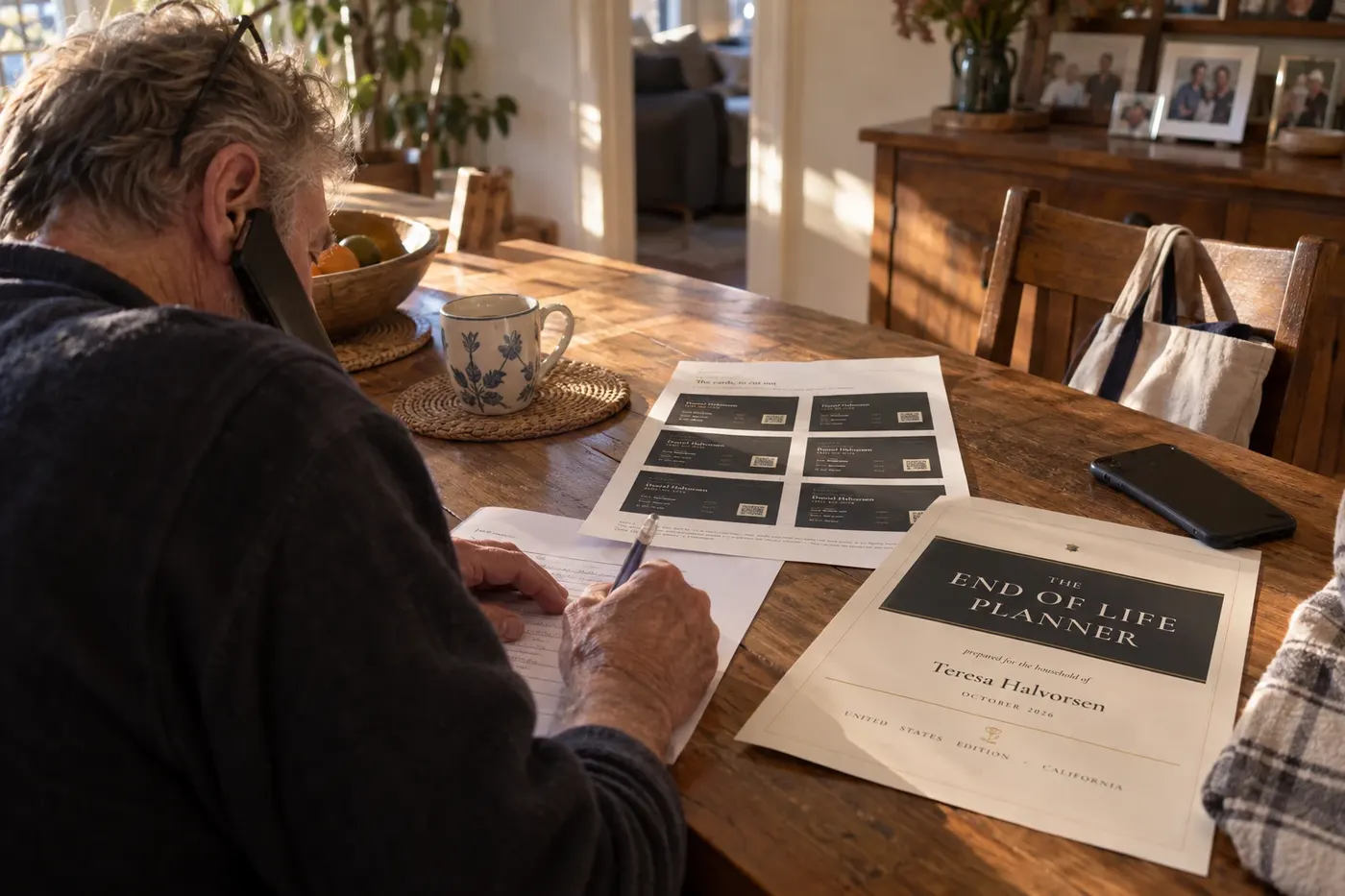
A man on the telephone with the planner's pages open on the table