

Skip to content
The Family Handover Kitby Valoren
Free · general informationQueensland

Executor checklist for Queensland: the tasks each official body publishes, body by body

The general tasks after a death in Queensland as the state's registry and Supreme Court, Transport and Main Roads, Titles Queensland, the Queensland Revenue Office, the Queensland Police Service, Services Australia, the ATO, the banks and the super funds publish them, each with the date it was checked and the body's own time limit where it gives one, laid out to print, and not a plan for any one estate.

Every line checked on 10 November 2026.

Prepared and checked by Valoren, a UK business, not an Australian law firm. This is general information, not legal advice about your circumstances.

Download the PDF

FreeA4 PDFQueensland

Download this checklist

The same rows as this page, each with a tick box and a date line, laid out for A4 and prepared from the same dated facts.

Download the checklist (PDF) 15 pages · 190 KB · prepared 14 October 2026

What this checklist is, and what it is not

Queensland · general information · checked 10 November 2026

This page lists the general tasks that official bodies publish for the time after a death in Queensland: the Queensland Registry of Births, Deaths and Marriages, the Supreme Court of Queensland, the Department of Transport and Main Roads, Titles Queensland, the Queensland Revenue Office and the Queensland Police Service, with the two federal bodies, the free national notifier, the banks and the super funds.

Every row is one task as that body describes it, with the body's own time limit where it publishes one, and a link to the page on this site that explains it.

People search for an executor checklist, so this page uses the word. It does not say what an executor must do, who the executor of a particular estate is, which tasks apply to the estate you are dealing with, which comes first, or whether a grant of probate or letters of administration is needed.

Each body can say what it asks for in a particular case, and a solicitor can look at the whole estate.

Three different time limits that sound alike appear on this page. One is the time Services Australia asks to be told within.

Another is the ATO's own time to update its records once it has been told. The third is the window some super funds give for objections to a proposed payment. The cards keep them apart.

The Queensland Government's own page for those handling the affairs of someone who has died: Queensland Government · Managing Affairs After a Death (the "What to do after someone dies" page says it can help those handling the affairs of someone who has passed away)

The national checklist, with all three states side by side, on this site

The first fortnight, state by state, on this site

The official power of attorney forms of Queensland, and what the bodies say
What belongs in an estate kit

At a glance

The executor checklist

Executor in Queensland
each with the date it was checked
  • the state's registry
  • the free notifier
  • the Supreme Court of Queensland
  • Services Australia
  • the ATO
  • Transport and Main Roads
  • Titles Queensland
  • the Queensland Revenue Office
  • the Queensland Police Service
  • the banks and the super funds
laid out to print, and not a plan for any one estate.

Registering the death and ordering the certificate

0 of 8 ticked

Ticks are kept on this device only. Nothing is sent.

Queensland · general information · checked 10 November 2026

The Queensland Registry of Births, Deaths and Marriages registers the death and issues the death certificate. It publishes who usually does this, its own time, two kinds of certificate, a fee and a processing time.

In Queensland, the funeral director usually registers the death on behalf of the family. The registry says the death needs to be registered within 14 days.

Where no funeral director is registering the death, it is registered by applying to the registry, by post or in person.

The registry says a death certificate can be ordered at the same time as registering a death with it.

Queensland issues two kinds of death certificate. The official certificate shows the cause of death and is the one used to finalise estate matters. The limited certificate does not show the cause of death and may not be accepted by all organisations.

The registry's published list of who can apply: the person's spouse, parent or child; the person who gave the details and signed the death registration; the funeral director; or an executor of the estate. Its page lists who else can apply. That is the registry's published list. This page does not say whether you can apply.

The registry's published fee for a death certificate is A$58.10, official or limited, or A$116.20 for one of each. An urgent application costs A$34.45 extra. Regular postage is free.

The registry's published processing times: up to 10 business days, or within 2 business days for an urgent application, which costs extra. Postage and public holidays add time.

A death certificate must have been issued before ADNS can be used.

Ordering the certificate, on the registry's page: Queensland Government · Get a death certificate

The registry's fee, its rule on who can apply, and its time, in more detail on this site

Once the certificate is issued: the free notifier

0 of 7 ticked

Queensland · general information · checked 10 November 2026

The Australian Death Notification Service (ADNS) is a free, national service.

ADNS says it is supported by all states and territories.

ADNS says it can be used by anyone with legal authority to administer the estate, and that they may be asked for documents showing it.

It takes the details of the person who has died and sends them to the organisations you choose from its list.

ADNS says a notification takes 5 to 15 minutes.

Those organisations should make contact within 10 business days.

Organisations choose whether to join. ADNS says it cannot make them take part.

ADNS suggests forwarding its confirmation email to organisations not on the service. It says the email holds all the details already entered.

Who the free notifier reaches, and who it does not, organisation by organisation

Before a court application: the notice the court publishes

0 of 5 ticked

Queensland · general information · checked 10 November 2026

A grant of probate or letters of administration is a Supreme Court document. This card and the next show what the Supreme Court of Queensland publishes about applying. Whether a grant is needed for a particular estate is not something this page says.

The court says a grant of probate is not always needed, and to check with the organisation involved, such as the bank, to confirm what it requires.

The court names three grants: probate; letters of administration with the will; and letters of administration without a will (intestacy).

Before applying, the intention to apply is advertised in the Queensland Law Reporter, using the wording in Form 103.

The court says the advertisement is submitted through the ICLRQ's online customer portal, and gives the ICLRQ's number for help: (07) 3236 1855.

The Queensland Law Reporter is published every Friday. A notice, with its payment, has to be in by 3:30 pm on the Monday before.

The ICLRQ's published rate for a notice in the Queensland Law Reporter is A$161.70, including GST.

After the notice appears in the Queensland Law Reporter, the court says to wait 14 days, to allow objections. If the registry is closed on the 15th day, filing is on the next business day.

A copy of the notice is also sent to the Queensland Public Trustee. The court says to wait at least 7 days after the Public Trustee receives it before filing.

Those are the court's own waits, as its page counts them. The help card below can point you to someone who can explain the timing for a particular application.

The Supreme Court of Queensland: the forms, the fee and what follows filing

0 of 7 ticked

Queensland · general information · checked 10 November 2026

People applying without a law firm file in person or by post at a Supreme Court registry in Brisbane, Cairns, Rockhampton or Townsville. Law firms lodge online.

Queensland Courts says the steps to apply are the same whether the grant is probate, letters of administration with the will, or letters of administration without a will (intestacy).

Application for probate, or for letters of administration with the will: Form 101.

Affidavit supporting a probate application: Form 105.

For letters of administration without a will, Queensland Courts lists Form 102 (application), Form 109 (affidavit, with a certified copy of the death certificate attached), Form 47 (certificate of exhibit) and Form 104 (affidavit of publication and service, with Form 103 attached).

The court says all forms must be completed electronically, not handwritten. This page does not say what to enter on any form.

The court's fee for filing an application for probate or letters of administration is A$847.60.

The court says the costs of an application include the advertising fee, the court's filing fee and the fee for the death certificate.

The Queensland courts say a person facing financial hardship can ask a registrar to reduce certain civil fees: filing fees for claims, appeals or applications, and setting-down and daily hearing fees. The fees page: Queensland Courts · Supreme Court fees

Section 51 of the Succession Act 1981, headed 'Abolition of administration bond and sureties', says neither an administration bond nor sureties in support of one are required of any administrator. That is the Act's own statement, and the only line on this page about a bond.

Where there is no valid will, the grant is letters of administration without a will (intestacy).

Rule 612 of the Uniform Civil Procedure Rules 1999 says the court must not make a grant on an intestacy within 30 days after the death, unless it considers urgent circumstances justify a grant before the end of the 30 days.

The court says applications filed in person or by post are digitised, which means a longer wait before the electronic grant is issued.

The court emails the grant.

If an application does not comply, the court sends its reasons. This is usually called a requisition.

The court says its registry staff cannot give legal advice.

Probate in Queensland, with the court's forms and fee in full, on this site

What the grant is called when there is no will, and where the court explains it, on this site

Services Australia and the ATO: two federal bodies, two different times

0 of 11 ticked

Queensland · general information · checked 10 November 2026

Services Australia is the federal agency behind Centrelink, Medicare and Child Support. The Australian Taxation Office is the other federal body on this page. Each publishes a time of its own, and they are not the same kind of time.

Services Australia says it needs to be told of a death within 28 days, in one of three ways: by calling the Older Australians line, by sending the Advice of death form, or at a service centre. This is Services Australia's time to be told.

Services Australia says it uses the Advice of death form to update records with Medicare, Centrelink and Child Support. The form: Services Australia · Advice of death form (SA116)

Services Australia says that when it is told about a death, it works out whether a payment can be made, and how much. This page does not say whether any payment will be made to anyone.

Services Australia (Centrelink, Medicare) · not on the ADNS list

The ATO says that if the supporting documents are not ready yet, its Individuals enquiries line can be told unofficially that the person has died, and it will pause the deceased's tax correspondence until you are ready.

One ATO form does both jobs: it officially tells the ATO of the death and of who will manage the estate.

The ATO says that if a grant of probate or letters of administration will be applied for, it is better to wait for the grant before sending the notification, to avoid delays.

This is the ATO's own suggestion about its own process. It is not a reason, on its own, to apply for a grant, and this page does not say whether a grant is needed.

After the online form is sent, the ATO asks for identity to be verified at a participating Australia Post outlet within 30 days.

The ATO says it takes up to 28 days to update the deceased person's records after it receives the notification. This is the ATO's time to act once told. It is not Services Australia's time to be told, above.

Australian Taxation Office · not on the ADNS list

The ATO says a final tax return for the income year in which the person died is called a 'date of death' tax return, and that it is different from the trust tax return for the estate.

This page does not say whether a return is needed for the estate you are dealing with, or whether tax will be owed.

How Services Australia and the ATO are told, and the ATO's identity check, on this site

The final return, the estate's tax file number and the ATO's tax pages, on this site

Transport and Main Roads: vehicle registration and number plates

0 of 12 ticked

Queensland · general information · checked 10 November 2026

The Department of Transport and Main Roads publishes a page on registration where the registered operator has died, with a question-and-answer tool on it. The lines below report what the department publishes, including the tool's own branches.

The Department of Transport and Main Roads says it may be told of a death by Births, Deaths and Marriages or by the person's next of kin, and then sends a letter to the person's last known address listing any vehicles or number plates in their name to be transferred or cancelled.

The Department of Transport and Main Roads says that when it is told a person has died it places a restriction on any vehicles and personalised or customised plates in their name, that the restriction does not cancel the registration, and that the registration cannot be renewed until it is transferred to an eligible person or legal entity.

The Department of Transport and Main Roads says a vehicle registered in two names can be transferred free of charge to the surviving registered operator, who produces proof of death (if a Registration Notice Individual Restriction letter has not been received) and original evidence of identity, and that no other forms or documents are required.

In its question-and-answer tool, the Department of Transport and Main Roads says that where there is a grant of probate or letters of administration, the original or certified copies of the grant are presented with form F5296 (Application to Transact with Registration Products on behalf of a Deceased Person), and the Will, a death certificate and the statutory declaration on that form are not needed.

In its question-and-answer tool, the Department of Transport and Main Roads says that where a grant of probate or letters of administration has been applied for but not yet granted, the deceased person's registration products cannot be finalised until the grant is made.

In its question-and-answer tool, the Department of Transport and Main Roads says that where there is a valid Will but no grant, the original or a certified copy of the last known valid Will is presented, the person is an executor named in that Will, and form F5296 is completed including the statutory declaration.

Those are branches of the department's own tool, as it words them. The tool asks its own questions, and this page does not say which branch applies to the estate you are dealing with.

The Department of Transport and Main Roads says that once a decision is made to transfer or cancel, an administrator, executor or next of kin presents original evidence of identity and pays any applicable fees, and that where there are several executors or administrators only one signs and presents original evidence of identity.

The Department of Transport and Main Roads says vehicle registrations can be temporarily transferred to the estate of the deceased person, with an administrator, executor or next of kin nominated as the second registered operator and responsible for the vehicle and registration until it is transferred out of the estate or cancelled.

The Department of Transport and Main Roads says that where the registered operator has died, the executor, administrator or next of kin transfers the registration into the Estate of the deceased or to another person before cancelling it, which it says makes sure any unused portion of registration is refunded to the correct person.

The Department of Transport and Main Roads says cancelling a registration involves the cancellation of registration form (F3517), one form for each registration when cancelling fewer than 5, and handing in the number plates (with a receipt), except for personalised or customised plates being kept or plates that are lost, stolen or destroyed, which are declared in Section 7 of the form.

The Department of Transport and Main Roads says the cancellation form can be submitted in person, by mail to Registration cancellations, PO Box 372, Longreach QLD 4730, or by email to regocancellations@tmr.qld.gov.au (email only if the plates have already been surrendered or are not required to be).

The Queensland Government's vehicle registration duty page says duty is not charged on vehicles from a deceased estate transferred to the personal representative of the estate or to a person beneficially entitled to the vehicle, and that a certified copy of the original will is provided to exercise powers as a personal representative, or the person shows they are an eligible beneficiary.

That is the government's own page on its own exemption. This page does not say whether duty applies to any vehicle, or who is entitled to one.

Transport and Main Roads: the driver licence

0 of 3 ticked

Queensland · general information · checked 10 November 2026

The Department of Transport and Main Roads says a current (not expired) driver licence surrendered on behalf of a deceased person may be eligible for a refund of the remaining time on the licence, applied for at a transport and motoring service centre or, if that is not possible, by mail, with the refund issued by cheque in the name of the licensee or the licensee's estate.

For a refund in person on behalf of a deceased person, the Department of Transport and Main Roads lists the deceased person's driver licence (unless it was lost, stolen or destroyed) and one supporting document: a death certificate, a Coroner's report, a certificate of authority issued by the Public Trustee under the Public Trustee Act 1978, a grant of probate stamped with court seal, or advice from the Registry of Births, Deaths and Marriages.

For a refund by mail on behalf of a deceased person, the Department of Transport and Main Roads lists a completed return/surrender declaration form (F4778), the driver licence (unless lost, stolen or destroyed) and a copy of a supporting document certified by a JP or other qualified person, posted to the Emerald Customer Service Centre, PO Box 1787, Emerald QLD 4720.

This page does not say whether a refund is due on any licence. The department's page, or its service centres, can.

Titles Queensland: recording a death, as the titles office publishes it

0 of 7 ticked

Queensland · general information · checked 10 November 2026

Titles Queensland says that where a person's name appears on a Queensland title, it is told of their death so that their property, mortgages and leases can be dealt with, by lodging the relevant forms with supporting evidence and paying the lodgement fee.

Titles Queensland says the first things to know are what interest the person held (owner, lease holder or mortgagee) and how they held it (sole owner, tenant in common or joint tenant), which a current title search can show, bought online from Titles Queensland or obtained from a solicitor.

Titles Queensland says that in most cases dealing with the property interest involves putting it in the name of either the personal representative of the estate (usually the executor/s in the will or those granted probate, who hold it on behalf of the estate) or the beneficiaries of the estate (also called the legatee or devisee).

That is the titles office's general description of its own applications. This page does not say whose name any title goes into.

Titles Queensland says that under a joint tenancy the interest of a joint tenant who dies passes immediately to the surviving joint tenant/s by survivorship, not under the will, and that the surviving joint tenant/s record the death with Titles Queensland to change the title.

Titles Queensland says the evidence of death for a joint tenant is a copy of the official certificate of death (short or long extract) from the relevant registry of births, deaths and marriages, and that a good quality photocopy certified as a true copy by a justice of the peace, commissioner for declarations or Australian lawyer is acceptable.

Titles Queensland's FY2026/27 fee schedule lists a lodging fee under the Land Title Act 1994 of A$46.56 for 1 lot for an instrument that changes ownership to record the death of an individual who is a joint tenant.

Titles Queensland says its Titles Electronic Drop Box is designed for self-representing individuals to lodge a limited selection of single-party dealings, including Form 4 (request to record death) and Forms 5 and 5A (transmission by death, grant issued), with its standard client service timeline for correctly lodged titling instruments being five business days.

The forms, on the titles office's own page: Titles Queensland · Forms

This page does not say how any property was held, or what a person needs to do to hold or sell land. Titles Queensland's pages, or a solicitor, can.

Titles Queensland: the transmission application, as its practice manual describes it

0 of 4 ticked

Queensland · general information · checked 10 November 2026

The Land Title Practice Manual says a transmission application registers an estate in the name of a new registered owner or holder after the death of a sole registered owner, sole holder of an interest, or the interest of a tenant in common, that the death of a joint tenant is dealt with by a Form 4 request to record death, and that a lot or interest may be transmitted to the personal representative (Form 5 or 5A) or to the devisee or legatee named in the last will (Form 6).

The Land Title Practice Manual says Form 5 is used by a personal representative who has obtained a grant of representation in Queensland, a reseal of a grant, or a Queensland recognised grant not resealed in Queensland, and lists the documents lodged with it, including probate (original or Supreme Court office copy), reseal of probate, letters of administration, or an election to administer with a certificate of authority.

The Land Title Practice Manual says the original will is generally lodged with the transmission application when probate has not been taken out, that original wills are treated with extreme care with no marks or holes made in them, and that an original will is not stapled to the application.

The Land Title Practice Manual says that where the Public Trustee is the applicant, a certificate is lodged if an order to administer or an election to administer is relied on, and that evidence of the order to administer is a certificate of authority issued under s. 138 of the Public Trustee Act 1978.

This page does not say which form, if any, applies to the estate you are dealing with, or what to enter on one.

Queensland Revenue Office: transfer duty on a death, as it publishes it

0 of 5 ticked

Queensland · general information · checked 10 November 2026

The Queensland Revenue Office publishes a page on its exemption from transfer duty where a property owner has died. Every line below reports what the office publishes, and none is a statement by this page about whether duty applies.

The Queensland Revenue Office says an exemption from transfer duty may be applied for when distributing the property of a deceased person's estate, where the transaction is made according to the will or the rules of intestacy.

The Queensland Revenue Office says no duty is paid on a transfer that results from the death of a joint tenant, because the deceased person's share passes immediately to the surviving joint tenant(s), and that this exemption does not apply to property held as tenants in common.

The Queensland Revenue Office says a transmission application for registration as devisee/legatee (Form 6) is not dutiable and does not require a stamp to be lodged with Titles Queensland.

The Queensland Revenue Office lists what is lodged to claim the exemption: a copy of the will or schedule of intestacy, the transfer documents, a dutiable transaction statement (Form D2.2), an identity details annexure for each non-Australian transferor and transferee when transferring real property, and a covering letter, with a schedule of distribution if the transfer is not in accordance with the will or intestacy.

The Queensland Revenue Office says receiving an interest in land from a distribution of a deceased estate may affect a beneficiary's land tax liability.

This page does not say whether duty or land tax applies to any transfer, or whether the exemption will be given. The office's page, or a solicitor, can say what applies.

Queensland Police Service: firearms, as the licensing body publishes it

0 of 1 ticked

Queensland · general information · checked 10 November 2026

The Queensland Police Service's Weapons Licensing Group is the licensing body. The lines below are its own, and this page gives no instruction about any firearm.

The Queensland Police Service says a permit to acquire is no longer valid if the licence it was issued to is suspended, cancelled, revoked, surrendered or expires, or the holder of the permit is deceased.

This page does not say what is to be done with any firearm, or who may hold one. The Weapons Licensing Group can.

Banks and super funds: each one's own route and time

0 of 9 ticked

Queensland · general information · checked 10 November 2026

Each bank and each super fund publishes its own route. A bank's figure for when it asks for a grant is its own rule for money held with that bank, and the figures differ, so none appears here.

The court says organisations such as banks and super funds often ask for formal proof, called probate.

Queensland Courts says its verification tool lets outside parties such as financial institutions confirm their clients' court-issued grants, which include letters of administration with or without a will.

It says a notification can be made online or at a branch appointment, even before any of the documents are to hand.

It says it will write within 14 business days confirming how the accounts have been protected and what to do next.

Westpac lists payments it can make even without probate, including funeral costs, probate application fees, medical fees and aged care facility bills.

How six banks say they handle a deceased customer's accounts, on this site

The ATO says the super fund's trustee works out who will receive the benefits. Super paid after a death is called a super death benefit.

The ATO says the super fund (or funds) should be contacted directly, to tell them of the death and discuss the release of the super. If there is no authorised legal personal representative, the ATO may inform the fund, which then decides whether to contact the family.

Aware Super says a dedicated case manager will contact the person who told it within 10 business days.

Claimants have 28 days from being notified of its decision to agree or object, and if one disagrees with the final decision, 28 days to complain to the Australian Financial Complaints Authority (AFCA), which it describes as free and independent. These are the fund's objection windows, not a time to tell anyone of the death.

This page does not say who a super benefit will be paid to. How each fund is told, and what the ATO says tax depends on, on this site

The documents each body names

0 of 9 ticked

Queensland · general information · checked 10 November 2026

Each body publishes what it asks to see. These are the lines gathered for this site, body by body. The body itself can say what it will accept in a particular case.

To notify the ATO of a death, it asks for one of these: the death certificate, the grant of probate or letters of administration, or the will.

The ATO says the documents shown at Australia Post need to be either originals or certified copies, and can be taken home afterwards.

To give an executor or administrator details from its records, Services Australia asks for proof of their authority to act on the estate and an Executor/Administrator request for information form, one from each executor or administrator.

The court keeps the certified copy of the death certificate and the original will or codicil on file. They cannot be returned.

For a refund in person on behalf of a deceased person, the Department of Transport and Main Roads lists the deceased person's driver licence (unless it was lost, stolen or destroyed) and one supporting document: a death certificate, a Coroner's report, a certificate of authority issued by the Public Trustee under the Public Trustee Act 1978, a grant of probate stamped with court seal, or advice from the Registry of Births, Deaths and Marriages.

Titles Queensland says the evidence of death for a joint tenant is a copy of the official certificate of death (short or long extract) from the relevant registry of births, deaths and marriages, and that a good quality photocopy certified as a true copy by a justice of the peace, commissioner for declarations or Australian lawyer is acceptable.

Queensland issues two kinds of death certificate. The official certificate shows the cause of death and is the one used to finalise estate matters. The limited certificate does not show the cause of death and may not be accepted by all organisations.

In all matters ING requires a certified copy of the death certificate issued by Births, Deaths and Marriages.

Hostplus's claims guide asks for a certified copy of the death certificate, with the cause of death if available, and one certified proof of the member's identity, such as a passport, birth certificate or driver's licence.

Where to order the death certificate in Queensland, on this site

Printing this checklist

This page is laid out to print. Use your browser's print or share menu. Every line shows the date it was checked, and the bodies change their pages, so a printed copy is a snapshot of that date.

The page itself is re-checked, and a line that cannot be confirmed is withheld rather than left to go stale.

This page cannot tell you what applies to the estate you are dealing with. The help card below lists Queensland's own routes to someone who can.

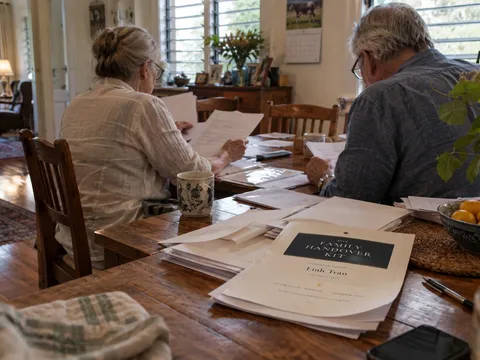
An older couple sorting papers at a long timber table in a Queensland house, the printed Family Handover Kit's Queensland cover on a stack in front of them
FAQ

Common questions

This page cannot say; each body publishes its own tasks, and this page shows them as that body words them. The Queensland Registry of Births, Deaths and Marriages, the Supreme Court of Queensland, the Department of Transport and Main Roads, Titles Queensland, the Queensland Revenue Office and the Queensland Police Service each have a card above, as do Services Australia, the ATO, the banks and the super funds.

Which of those tasks apply to a particular estate, and who its executor is, are for the court or a solicitor to say. The court's own line on what a grant does: The Supreme Court of Queensland says administering an estate often needs a court-issued grant, which gives someone the legal authority to act. Probate in Queensland, on this site

Queensland · general information · checked 10 November 2026

Three official pages come close, and this page draws on all three. The Queensland Government's own page for those handling someone's affairs: Queensland Government · Managing Affairs After a Death (the "What to do after someone dies" page says it can help those handling the affairs of someone who has passed away) Services Australia's list of who to tell: Services Australia · Who to tell when someone dies The ATO's list, for tax, shows its own last-updated date: ATO · Checklist: what to do when someone dies (the page shows "Last updated 16 September 2026") None of them is a plan for a particular estate, and neither is this page.

Queensland · general information · checked 10 November 2026

This page cannot say. The court explains it in general terms. The court says a grant of probate is not always needed, and to check with the organisation involved, such as the bank, to confirm what it requires.

The court says organisations such as banks and super funds often ask for formal proof, called probate.

So the bank, fund or other body holding an asset can tell you what it asks for before it releases that asset, and a solicitor can look at the whole estate. The court's own page says more, in general terms: Queensland Courts · About grants of administration (including when a grant may not be needed) Probate in Queensland, on this site

Queensland · general information · checked 10 November 2026

The registry publishes one, Services Australia publishes one, and the court publishes two waits before an application is filed. The registry: In Queensland, the funeral director usually registers the death on behalf of the family. The registry says the death needs to be registered within 14 days.

Services Australia: Services Australia says it needs to be told of a death within 28 days, in one of three ways: by calling the Older Australians line, by sending the Advice of death form, or at a service centre.

The court's waits are in the notice card above. The ATO's time is a different kind of time: The ATO says it takes up to 28 days to update the deceased person's records after it receives the notification. That is the ATO's time to act, not a time to tell it.

Queensland · general information · checked 10 November 2026

The Department of Transport and Main Roads publishes its own process, and this page shows it as the department words it.

The Department of Transport and Main Roads says it may be told of a death by Births, Deaths and Marriages or by the person's next of kin, and then sends a letter to the person's last known address listing any vehicles or number plates in their name to be transferred or cancelled.

The Department of Transport and Main Roads says that when it is told a person has died it places a restriction on any vehicles and personalised or customised plates in their name, that the restriction does not cancel the registration, and that the registration cannot be renewed until it is transferred to an eligible person or legal entity.

The department's tool then asks its own questions about the grant and the will, and its branches are in the registration card above. This page does not say which branch applies. The department's page: Queensland Department of Transport and Main Roads · Transferring registration from a deceased registered operator (the page shows "Last updated: 11 September 2026")

Queensland · general information · checked 10 November 2026

Titles Queensland says that where a person's name appears on a Queensland title, it is told of their death so that their property, mortgages and leases can be dealt with, by lodging the relevant forms with supporting evidence and paying the lodgement fee.

Titles Queensland says the first things to know are what interest the person held (owner, lease holder or mortgagee) and how they held it (sole owner, tenant in common or joint tenant), which a current title search can show, bought online from Titles Queensland or obtained from a solicitor.

Its forms and its practice manual are in the two Titles Queensland cards above. This page does not say which form applies, or whose name a title goes into. Its page: Titles Queensland · Recording a death with Titles Queensland

Queensland · general information · checked 10 November 2026

This page cannot say whether duty applies to any transfer. The Queensland Revenue Office calls it transfer duty and publishes its own lines about its exemption; these are two of them.

The Queensland Revenue Office says an exemption from transfer duty may be applied for when distributing the property of a deceased person's estate, where the transaction is made according to the will or the rules of intestacy.

The Queensland Revenue Office says no duty is paid on a transfer that results from the death of a joint tenant, because the deceased person's share passes immediately to the surviving joint tenant(s), and that this exemption does not apply to property held as tenants in common.

What it says is lodged to claim the exemption is in the Revenue Office card above. Its page: Queensland Revenue Office · Death of a property owner exemption (the page shows "Last updated: 3 June 2026")

Queensland · general information · checked 10 November 2026

It is laid out to print, and a browser's print or share menu can save it as a PDF. Every line shows the date it was checked, and the bodies change their pages, so a printed copy is a snapshot of that date.

The cards above are what Queensland's own bodies and the two federal bodies publish; nothing is numbered as a step, and nothing on the printed copy says which task applies to a particular estate.

Where to get help with your situation

This page cannot tell you what applies to the estate you are dealing with. These official routes can point you to someone who can.

Queensland

Queensland · general information · checked 10 November 2026

Valoren does not choose a solicitor for you, and takes no payment from any.